 Southwest
Environmental LimitedSouthwest
Environmental Limited
Southwest
Environmental LimitedSouthwest
Environmental Limited| London |
| 02076 920 670 |
| Exeter |
| 01392 927 961 |
| Manchester |
| 01612 970 026 |
| Bristol |
| 01173 270 092 |
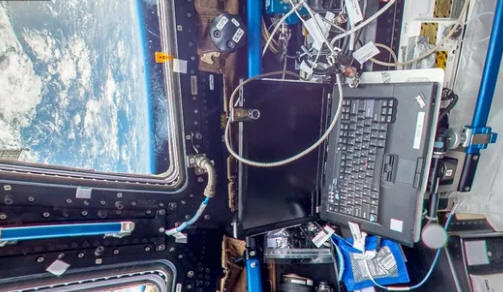
If you would like to see what a robust and long lasting portable computer looks like. . . then take a trip 250 miles upwards to the International Space Station. There you will find a ThinkPad A61p still in use (see image below). These laptops were installed on the space station in 2009 and after 17 years some are still in use for web-browsing and other useful tasks. Probably the single biggest boost for these old space born machine is the use of Linux operating system, which supports older hardware, retaining its functionality.
In fact we are so set against the bloat ware, background processing demand and forced obsolescence (Windows 11 is even picky about processors!) that we would suggest it would be very hard to put an ecolbel on a consumer grade Window machine, unless it was very high performance (lots of headroom).
We at SWEL have never manufactured a computer, but we do know a lot about PCB manufacture, use of plastics, and recycling batteries. That is a lot of boxes ticked.
The EU Ecolabel for portable computers is one of the most prestigious certifications in tech. It tells the consumer that the device isn't just fast, but that it was built to last, can be fixed if it breaks, and uses minerals that didn't fund armed conflict.
Follow these five steps to navigate the complex technical report for laptops and tablets:
The Background Report uses Energy Star 8.0 (or the most recent version) as a baseline but adds stricter EU-specific requirements.
The Requirement: You must provide data on the device’s "Typical Energy Consumption" (TEC).
The Goal: The laptop must exceed standard efficiency targets in "Sleep," "Long Idle," and "Off" modes. This ensures that even when the device is plugged in but not in use, its environmental impact is negligible.
This is the most critical section of the report. The EU wants to end "planned obsolescence."
Ease of Disassembly: You must provide a "Repairability Manual." This proves that a professional (or even a savvy consumer) can replace the battery, the screen, and the keyboard using common tools.
Spare Parts Availability: You must guarantee that essential spare parts will be available for at least 5 to 7 years after the model is discontinued.
Component Strength: Laptops must pass "drop tests" and keyboard "lifetime stroke tests" to ensure the hardware doesn't fail under normal stress.
Since the battery is the most common point of failure, the Background Report sets high standards for its "cycle life."
Cycle Count: The battery must retain at least 80% of its original capacity after 1,000 charge cycles.
Information Transparency: The device must have software that tells the user the "state of health" of their battery in real-time, encouraging better charging habits.
While all electronics must meet RoHS standards, the Ecolabel goes further into the "Background Report" requirements:
Flame Retardants: No chlorinated or brominated flame retardants are allowed in the plastic casings or circuit boards.
Recycled Content: Points are awarded (and sometimes required) for using Post-Consumer Recycled (PCR) plastic in the chassis.
Mercury-Free: The display panel (LCD/OLED) must be 100% mercury-free.
Portable computers require rare earth elements and minerals like Cobalt, Tantalum, and Tin.
Due Diligence: You must provide a report on your supply chain. This proves you are sourcing minerals responsibly and aren't contributing to human rights abuses in mining regions (e.g., the DRC).
Take-Back System: The manufacturer must offer a free "take-back" or recycling scheme for the device at the end of its life, ensuring the hazardous components don't end up in general landfill.
The "Design for Recycling" criteria are the hardest to hit. If your client uses excessive "permanent adhesives" (glue) to hold the battery or screen in place, they will fail. Advise engineering teams to switch to screws or pull-tab adhesives early in the prototyping phase.
We can offer a full fixed price services, or just help out with a few hours work here and there. Contact us for help (hit the big yellow button at the top of page)
The below section was written by a machine.
Manufacturers of portable computers, including laptops, notebooks, tablets, and two-in-one devices, can demonstrate superior environmental performance by securing the EU Ecolabel. This certification focuses on energy efficiency, hazardous substance reduction, and the longevity of the device, aligning your brand with the growing demand for sustainable electronics.
Southwest Environmental Limited provides expert technical support to navigate the complex application process. We assist in gathering evidence for energy consumption benchmarks, battery performance, and the ease of repair and upgradeability, which are critical pillars of the "Flower" label for electronics. This technical rigor is essential for manufacturers aiming to qualify for public procurement contracts within the European Union.
The EU Ecolabel provides your product with instant credibility and market access across all EU member states. We help you manage the certification recognized in:
To qualify for the EU Ecolabel, portable computers must meet strict criteria that exceed standard regulatory requirements. Our consultancy focuses on:
Our expertise extends beyond product labeling. For manufacturers operating large-scale assembly or research facilities, we provide comprehensive Environmental Engineering solutions. This includes designing Sustainable Drainage Systems (SuDS) to manage facility surface water and providing technical data for Energy Strategies.
Furthermore, we can integrate your product certification into a broader corporate framework through our Zero Cost ESG Consultation. This ensures that your achievement of the EU Ecolabel is accurately reflected in your Sustainability Statement and Whole Life Carbon Assessments.
With a 15-year history and over 900 projects completed across the UK, SWEL offers the professional authority and cross-disciplinary expertise needed to secure your environmental certifications and lead the market in sustainable technology.