 Southwest
Environmental LimitedSouthwest
Environmental Limited
Southwest
Environmental LimitedSouthwest
Environmental Limited| London |
| 02076 920 670 |
| Exeter |
| 01392 927 961 |
| Manchester |
| 01612 970 026 |
| Bristol |
| 01173 270 092 |
Would you like Southwest Environmental to produce a desktop study for your planning application? Please contact us for a quote.
As a condition of their planning application a client based in the midlands was asked (by the local planning authority) to complete a Phase 1 Desktop Study as a condition of his planning approval. After finding Southwest Environmental Limited (Environmental Consultants) Listed on Google, he instructed us to assemble a report.
 After a thorough site walk over
survey it was not apparent that the site had an industrial past, nor was
there any evidence of land contamination.
After a thorough site walk over
survey it was not apparent that the site had an industrial past, nor was
there any evidence of land contamination.
On returning to the office a third party data set was purchased from a
specialist supplier. The data set includes details of potential
Sources, Pathways and Receptors
in the immediate area.
Sources: Petrol Stations, Work Shops, Vehicle Repairs,
Printing Shops and Dry Cleaners were all identified as being in the
area.
Pathway: Geological and Hydro geological maps are
included in the data that can be used to determine possible pathways
through soils, lithology or groundwater. Pathways can take pollution off
site or bring contaminants on site.
Environmental Receptors such as RAMSAAR sites and SSSI's are listed in the data, if present this was not applicable in this instance. Groundwater is also designated zones in terms of it vulnerability, no ground water vulnerability zones were present under the site.
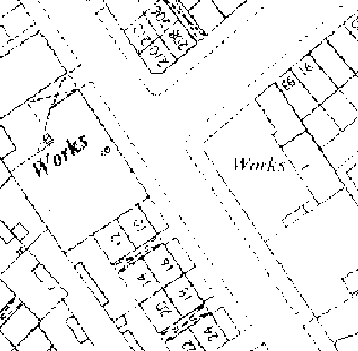
Historic maps showed conclusively that the site in
question had an industrial heritage, as the map to the left shows,
(sorry about the quality but the map is 100 years old) there had been
various uses associated with the site, soap works and generic "works"
being labeled on a number of maps. This project involved the delivery of a comprehensive preliminary risk assessment for a client in the Midlands who required a technical report to satisfy a planning condition. While an initial site walkover survey revealed no immediate visual evidence of contamination or historical industrial activity, a detailed review of environmental datasets and historical mapping was essential to fulfill regulatory requirements. Our approach ensures that all potential pollutant linkages are identified early, providing the necessary evidence for a successful planning application and contributing to the technical robustness of a broader planning statement. Technical analysis of historical maps dating back over a century identified that the site had a significant industrial heritage, specifically as a soap works and other generic industrial facilities. These findings were cross-referenced against geological and hydrogeological data to evaluate the potential for contaminant migration through the soil and lithology. This stage is a critical component of a wider environmental impact assessment and often informs the initial requirements for a groundwater risk assessment, particularly if the site is situated near sensitive receptors or water abstraction points. The resulting conceptual site model identified that while modern use appeared benign, the historical industrial legacy posed a potential risk to human health and the environment. Consequently, the report recommended an intrusive phase 2 site investigation to quantify the concentrations of contaminants in the ground. This transition from qualitative desk-based research to quantitative field data is necessary to determine if a phase 3 remediation strategy will be required to make the site fit for its intended use. Understanding these risks before the exchange of contracts or the commencement of construction is vital for managing project budgets and timelines. Our work on this project demonstrates the value of professional technical advocacy in navigating the land contamination risk management framework. By integrating historical data with modern environmental modeling, we provide developers with a clear path toward regulatory approval. Whether you are addressing surface and foul water drainage constraints or managing complex land quality issues, our technical reports offer the scientific rigor needed to move a project from a conditional approval to a fully discharged planning status. With over 900 projects delivered across the UK, SWEL remains a trusted partner for environmental consultancy and planning support.
After completing the site specific conceptual model and the site
specific risk assessment (qualitative) the final recommendations were
made.
In this case it was recommended that further investigations were carried
out, a Phase 2 Site Investigation
was recommended, with a associated Quantitative Risk Assessment.
It is often an unfortunate occurrence when a land owner discovers that
his land may be contaminated as there is considerable cost involved in a
Phase 2 Investigation, SWEL always
recommend carrying out a Desktop Study
Before the exchange of contracts.Project Recap