 Southwest
Environmental LimitedSouthwest
Environmental Limited
Southwest
Environmental LimitedSouthwest
Environmental Limited| London |
| 02076 920 670 |
| Exeter |
| 01392 927 961 |
| Manchester |
| 01612 970 026 |
| Bristol |
| 01173 270 092 |
Would you like a Zero Cost ESG Consultation. Let us review your current practices, and get back to you with some ideas.
Here at SWEL we have been writing scientific & compliance reports since 2009. This gives us an amazingly broad context. Our expertise covers the full spectrum of ESG strategy and compliance for industries such as:
If you would like help with ESG Due Diligence Reporting please contact us (big yellow button top of page. . . or call for a chat (no oblogation))

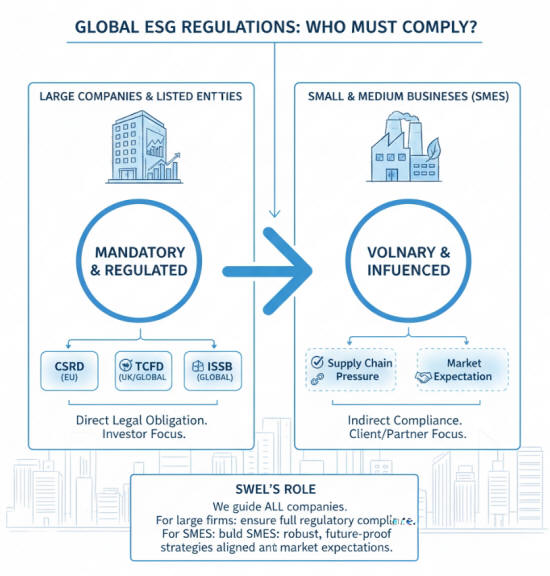
The current ESG landscape is defined by a shift toward mandatory, assured disclosure, driven by regulations like CSRD. Investors increasingly demand reliable Nature-related and Scope 3 data. The focus is moving from simple reporting to verifiable impact, integrating environmental and social risk across the entire corporate value chain.
SWEL helps companies identify ESG stakeholder drivers through structured Stakeholder Engagement Services, ensuring their sustainability strategy is aligned with the expectations of investors, regulators, customers, and employees.
Our process focuses on:
Stakeholder Mapping & Prioritization: We don't just list stakeholders; we use tools like Power/Interest Grids to identify and prioritize groups most impacted by, or most influential on, your ESG performance. This identifies key drivers like Investor demand for climate risk reporting (TCFD) versus Community concern over local environmental impact.
Materiality Assessment Facilitation: We guide the crucial Materiality Assessment process, which uses stakeholder input (via surveys, interviews, and workshops) to determine which ESG issues are most financially significant to your business and most important to your stakeholders. This helps filter generic ESG topics down to the few, critical drivers you must address.
Regulatory Benchmarking: We monitor and advise on evolving legislative drivers, ensuring your strategy anticipates new mandates (like CSRD or CSDDD) from Regulators, which often dictate the minimum disclosure expectations of other stakeholders.
By integrating these inputs, SWEL provides a clear, defensible roadmap that meets specific demands (e.g., employees demanding better Social policies; customers seeking verified Environmental claims).
SWEL provides targeted environmental consulting services to help
companies capitalize on key ESG Investing Trends, turning regulatory
pressure into a competitive advantage.
We directly address the demand for reliable data and mandatory
disclosure through:
By integrating these services, SWEL ensures your sustainability strategy is both a vital risk mitigation tool and a clear driver of investor confidence and long-term business resilience in the new ESG landscape.
ESG Governance focuses on the management and oversight of a company's environmental and social performance. It ensures accountability through board-level responsibility, clear internal controls, and ethical decision-making. Effective governance is critical for translating ESG goals into measurable outcomes, ensuring data integrity, and aligning corporate strategy with stakeholder interests.
SWEL helps companies define clear Board Roles for ESG oversight by focusing on the core principles of accountability and integration in the current regulatory environment.
Our service ensures that ESG responsibilities are integrated at the highest level and not confined to a single committee. We assist the Board in:
Establishing Accountability: We help assign specific ESG pillars—such as climate risk (E), human capital (S), and anti-corruption (G)—to relevant committees (e.g., Audit for compliance, Nominating for social metrics). This clarifies who owns the risk and the strategy.
Defining Expertise Gaps: We assess the current Board skills matrix against emerging needs (e.g., expertise in Biodiversity Net Gain or Scope 3 emissions). We then advise on the ideal composition, or the necessary external training, required to provide competent oversight.
Oversight of Materiality: SWEL structures the Board's role in reviewing and approving the Materiality Assessment, ensuring that disclosed ESG issues are genuinely relevant to the company's financial and operational strategy, as mandated by frameworks like CSRD.
By defining these roles, SWEL ensures ESG is treated as a strategic
business imperative, providing the governance clarity needed to meet
investor and regulatory demands.

Fiduciary duties require company
directors and trustees to act in the best long-term financial interests
of the organization and its beneficiaries.
SWEL helps by providing the auditable, scientific evidence needed to satisfy these duties. We conduct ESG Due Diligence, Physical Climate Risk Assessments, and BNG compliance to ensure directors have robust, expert data to demonstrate they are acting diligently and managing the full spectrum of material risks.
SWEL helps companies strategically integrate ESG by focusing on two core areas: defining materiality and setting effective targets.
We facilitate the crucial Materiality Assessment process, which is the foundational step. This involves engaging stakeholders (investors, customers, regulators) to identify which environmental, social, and governance issues are most financially and operationally significant to your business. We then filter these issues using scientific and regulatory insights to create a Materiality Matrix, ensuring your resources are focused on the highest-impact areas (e.g., specific Scope 3 emissions or Biodiversity Net Gain).
Once material issues are defined, we help translate them into robust, measurable ESG targets. This includes setting Science-Based Targets for carbon reduction and designing detailed implementation plans for ecological goals (like BNG delivery or TNFD preparedness). By aligning your strategy with verifiable, material targets, SWEL ensures your ESG efforts drive genuine business value and satisfy the demanding scrutiny of investors and regulators.
SWEL specializes in translating your identified material ESG issues into an integrated, actionable risk management framework, protecting value and ensuring regulatory resilience.
We help manage risks by:
Quantifying Material Risk: We go beyond qualitative statements to provide expert, site-specific assessments of environmental risks. This includes modelling Physical Climate Risk (e.g., flood vulnerability) and quantifying regulatory exposure, giving your enterprise risk management (ERM) framework credible data to prioritize mitigation efforts.
Value Chain Diligence: We manage the complex risks in your supply chain (a key material issue). We conduct Scope 3 emissions analysis and implement Supply Chain Due Diligence protocols to identify and remediate social and environmental breaches well before they lead to regulatory fines or reputational damage (e.g., CSDDD compliance).
Compliance Assurance: For environmental matters, we ensure risks are mitigated through proven compliance. This includes providing Biodiversity Net Gain (BNG) strategies and ecological assessments that satisfy legal requirements, turning ecological liability into compliant, planned development.
By embedding our technical data into your risk protocols, SWEL ensures your company proactively manages material issues, transforming potential threats into controlled outcomes.
SWEL helps companies ensure robust ESG data quality by establishing rigorous collection standards and processes crucial for compliance and investor trust. We focus on transforming raw operational data into verifiable metrics.
We achieve this by:
Defining Material Metrics: Implementing the correct industry-specific metrics aligned with frameworks like CSRD and ISSB, ensuring you collect data that truly matters.
Establishing Internal Controls: Developing documented data governance protocols and auditing processes to ensure consistency, accuracy, and comparability across all sites and departments.
Data Verification: Providing third-party technical assessments (e.g., in carbon and ecology) to independently verify the accuracy of the data before disclosure. This confidence is essential for avoiding greenwashing penalties and satisfying investor due diligence.
Environmental, Social, and Governance): A framework of three factors used by investors and stakeholders to evaluate a company's ethical, sustainable, and responsible practices.
(Corporate Sustainability Reporting Directive): An EU law mandating large companies to report detailed, audited information on their ESG risks and impacts using "double materiality."
(Task Force on Climate-related Financial Disclosures): A foundational global framework providing recommendations for companies to disclose climate-related financial risks and opportunities across four pillars.
(International Sustainability Standards Board): A global body setting consistent standards (IFRS S1/S2) for sustainability-related financial disclosures to meet the needs of capital markets.
(Corporate Sustainability Due Diligence Directive): An EU law requiring large companies to identify, prevent, and mitigate adverse human rights and environmental impacts in their value chain.
(Biodiversity Net Gain): A mandatory UK policy requiring property developers to ensure habitats are measurably 10% better for nature than before development.
The below section was written by a machine.
Environmental, Social, and Governance (ESG) due diligence is an essential process for investors and developers to identify, assess, and manage risks and opportunities within a project or portfolio. At Southwest Environmental Limited (SWEL), we provide technical ESG reporting that translates complex environmental data into actionable insights for the property and investment sectors.
The environmental pillar of ESG focuses on the long-term sustainability and physical resilience of an asset. Our technical assessments evaluate several critical factors:
For those in the property sector, ESG factors directly influence asset value and marketability. We support clients through various stages of the investment lifecycle:
As a verified NATO and industrial supplier with a 15-year track record and over 900 projects completed, Southwest Environmental Limited offers the professional accreditation required for high-stakes ESG reporting. Our technical authority is established through memberships in the IES, IAQM, and BIAC. Led by Director Will Thorpe, we combine multidisciplinary expertise to ensure that ESG reports are backed by verifiable data and robust environmental modeling, providing a clear route to sustainable growth.