 Southwest
Environmental LimitedSouthwest
Environmental Limited
Southwest
Environmental LimitedSouthwest
Environmental Limited| London |
| 02076 920 670 |
| Exeter |
| 01392 927 961 |
| Manchester |
| 01612 970 026 |
| Bristol |
| 01173 270 092 |
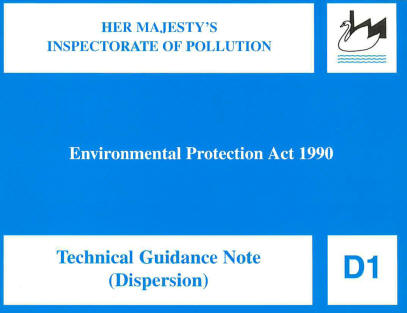
Back in 1993, the "Inspectorate of Pollution" released Technical Guidance Note D1. Despite being withdrawn it is still a key document used in calculating stack height, although there are many other methods that can be used.
Since the withdrawal of D1, the Environment Agency and DEFRA direct operators to use more robust assessment frameworks:
Although no longer considered "Best Practice," the D1 method is still occasionally used as a preliminary screening tool or for very small-scale, low-risk installations where full computer modeling would be disproportionately expensive.
Technical Guidance Note D1 and AERMOD represent two different eras of air quality assessment. While D1 was a manual calculation designed for simplicity, AERMOD is a sophisticated software package that accounts for the complex physics of the atmosphere.
| Feature | D1 Method (Withdrawn) | AERMOD (Modern Standard) |
|---|---|---|
| Calculation Basis | Manual algebraic equations and look-up tables. | Computer-based numerical modeling of atmospheric turbulence. |
| Meteorological Data | Uses a fixed 98th percentile for weather conditions. | Uses hourly sequential weather data, often over 5-year periods. |
| Terrain Impacts | Assumes flat terrain and does not account for hills or valleys. | Full integration of digital elevation models to account for complex topography. |
| Building Downwash | Very limited adjustment for nearby structures. | Advanced algorithms to calculate how buildings pull plumes toward the ground. |
| Regulatory Status | Withdrawn in 2016; used only for very basic screening. | Preferred standard for Environment Agency and local authority permits. |
The below section was written by a machine.
The calculation of chimney heights has evolved significantly since the 1993 release of Technical Guidance Note D1. While D1 remains a familiar legacy tool for basic screening, modern regulatory standards in the UK now prioritize high-resolution computer modeling to ensure human health and habitats are protected from industrial emissions.
Despite its historical importance, the D1 method has been largely superseded by sophisticated digital frameworks. Current environmental policy requires a level of precision that manual algebraic equations simply cannot provide.
For most environmental permit applications and Environmental Impact Assessments (EIA), the Environment Agency and local authorities now expect the use of ADMS or AERMOD software. These models use five-year hourly sequential weather data to provide a robust analysis of pollutant dispersion.
Southwest Environmental Limited (SWEL) provides technical authority for projects requiring air quality evidence. We can assist in determining whether a project requires a full dispersion model or if a simpler H1 Risk Assessment screening is sufficient. Our expertise ensures that your stack height design is not only compliant with Building Regulations but also optimized for long-term operational sustainability. By linking air quality data with ammonia emissions modeling and odour impact assessments, we provide a comprehensive route to securing planning consent across the UK.
With over 900 projects completed, our consultancy offers the professional accreditation required to navigate the complexities of modern atmospheric physics and regulatory high-barriers.