 Southwest
Environmental LimitedSouthwest
Environmental Limited
Southwest
Environmental LimitedSouthwest
Environmental Limited| London |
| 02076 920 670 |
| Exeter |
| 01392 927 961 |
| Manchester |
| 01612 970 026 |
| Bristol |
| 01173 270 092 |
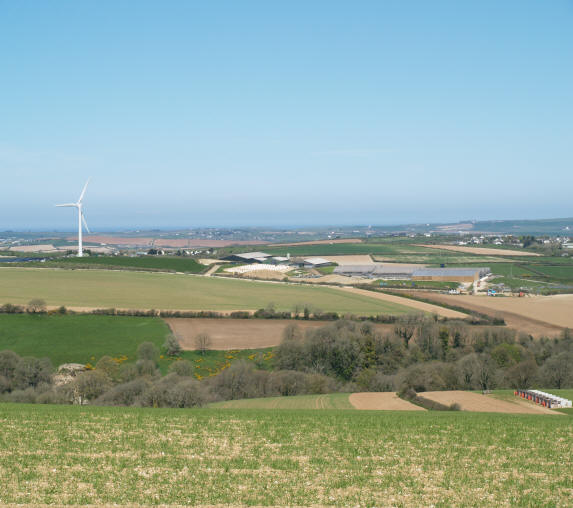 Windturbines are getting bigger and bigger, larger
turbines pay off there investment (carbon as well as financial) more
quickly
than any other renewable energy source. Some turbines are in excess of
100 meters tall, and so many require an assessment of their visual impact.
Windturbines are getting bigger and bigger, larger
turbines pay off there investment (carbon as well as financial) more
quickly
than any other renewable energy source. Some turbines are in excess of
100 meters tall, and so many require an assessment of their visual impact.
A thorough site survey
is the key to a
visual impact assessment
and no exceptions were made in this instance.
The report for a wind turbine in Cornwall includes photo montages and 3D models
of the proposed wind turbine, the software used can virtualize images as
seen from receptors (people living around the area) and give planners an
idea of likely impacts.
3D Model Shots from
Visual Impact report
2.0
Local Plan & Other Local Documentation
3.0
Natural Landscape Character
4.0
Landscape Character Area
5.0
Landscape and Visual Impacts
6.0
Mitigation
7.0
Conclusions
8.0 Certification

The model shot to the left shows a
proposed wind turbine visual impact with existing tree cover, and another existing
turbine to the right.
The model doesn't show all of the
vegetation, as the computer could not compute such a complex
model. Instead representative vegetation is added at points
where it lessens impacts. This type of model is call a bare
earth model (with added trees!)

| The model shot to the right shows a hedge
which run to the left of a foot path. The foot path goes past a
large wind farm (a site with multiple turbines) in around 1/2
mile. Turbine tips of other wind farm are just visible on the
horizon. If you require a Visual Impact Assessment Report then please get in contact. |
Cold Northcott Windfarm - Google Sketchup Modelling
The below section was written by a machine.
As renewable energy targets drive the development of larger wind turbines—often exceeding 100 meters in tip height—the requirement for a robust Landscape and Visual Impact Assessment (LVIA) becomes a critical component of the planning process. A VIA provides the technical evidence necessary to balance the carbon benefits of wind energy against the preservation of landscape character and visual amenity for local receptors.
A thorough assessment goes beyond static imagery, utilizing geospatial data and advanced modeling to predict visual change accurately. This is essential for satisfying the requirements of both local planning authorities and statutory consultees like Natural England.
Visual impacts are frequently assessed alongside other environmental constraints to provide a comprehensive Environmental Impact Assessment (EIA). At SWEL, we ensure that landscape mitigation strategies align with broader project goals.
With 15 years of industry experience and a portfolio of over 900 projects, SWEL offers the professional accreditation and technical insight required to navigate complex renewable energy applications. Our use of virtualization software allows planners and stakeholders to see the future impact before a single blade is installed, ensuring transparent and data-driven decision-making.