Tag Archives: BNG

How many BNG Credits per Acre?

How many BNG Credits per Acre?

If you are considering giving up some of you farm land for BNG credits, then of course you will need to know how many BNG credits you will get per acre. The land you are giving up for BNG will be out of use for many years and as such it is only right to investigate the returns you might expect.

BNG Credits are created by changing land from one use to another. For example a field to woodland, or some low lying meadows in to wetlands.

Not Just “How Many”

The first thing to realize is that it is not just a case of “how many”. As with wine or stamps the price of credits varies based on “distinctiveness“. Grassland may have quite low “distinctiveness”, whilst a lake would have very high distinctiveness. This can affect the price of each credit by 400%. (£40,000 to £200,000 or more).

Wetlands are a Very Good Option for BNG

But. How Many BNG Credits per Acre?

The short answer might be about 1 BNG Credit per Acre. Or 2 BNG Credits per Hectare.

This is based a few real world examples we have worked on where say 4 hectares of marginal land yielded around 7 BNG Credits.

But of course it is not that simple. The credits come from improvements in biodiversity. So if you start with good bio diversity (say scrub) then you will gain less when you “upgrade” to woodland.

Your best possible “yield” would be to upgrade mono-cultural farmland to something like a swamp or lake. But in terms of profit (especially in the long term) perhaps it is better to use scruffy marginal land and make fewer credits.

A last word. If you are think perhaps you could “tidy up” an area and then re-wild it in a year of two remember that what you do is all being recorded by satellites (google earth), and part of the process if proving that the land has not recently been changed.

Prices Can Vary Per Unit

Want to Know More

If you would like to know how much money you could make from BNG credits, then please do contact us (wt@southwest-environmental.co.uk) and we can arrange for our ecologist to advise you on the best way forward.

BNG Exemption Statement Bristol

BNG Exemption Statement Bristol

Do you need to fill out your BNG Exemption Statement in Bristol. We can do that.

What is It?

It companies 4 questions:

  • 1. Does the development qualify as a ‘householder application’?
  • 2. Is the development undertaken solely or mainly for fulfilling the BNG condition of another development?
  • 3. Does the development consist of no more than 9 self-build or custom build dwellings on a site no larger than 0.5 hectares?
  • 4. Does the development impact less than 25 square metres of onsite habitat or less than 5 metres of onsite linear habitat, and does not impact a priority habitat?

You go from one step top the next, and if you come out clear then you don’t need to to BNG.

Exemption Statement

This involves filling out various section of a form. Find the below hints on how to do this. Bristol City Council have provided an example you can follow.

5 – Habitats regulation wording.

6 – Go through the checks as shown at beginning of the form,

7 – Take Photos, or use history function on google earth to show ground cover over year on site. Overlay the site boundary on to these plans so you can see what the areas involved are and how big they are.

8 – Talk about how you will install bat boxes and that short of thing.

Get Us to Do it For You

No job too small for us, and we expect you would rather not do this sort of thing. Please let us do it for you, it will not cost much and you will have more time for living life (to the max :-/)

Contact Us

Email:

swenviro+bristol@gmail.com

Telephone:

01173 270 092

Nutrient Credit & BNG Credits – Lessons Learned

Nutrient Credit & BNG Credits – Lessons Learned

This is a dictated blog post so please excuse the poor punctuation although I expect the speech to text algorithm I’m using probably does a better job at a spelling than I do so at least that’s something! I also tried to write this as informally as possible and also put some very slight humour in it. . . .  this isn’t a reflection of my lack of sincerity with regards this topic but apparently if I am to keep ahead of AI then I need to inject humor and humans sensibility into my written content . . .  so there we go Brave New World. . . .

We’ve finally come to a point with nutrient neutrality where we have a complete system for measuring the inputs & outputs (which has been the case for a few years), and we also now (as of just a few weeks ago) have a complete legal system (in some areas at least) for the delivery of nutrient credits from off-site sources.

This took around two years to arrange and I’m a bit apprehensive about the same thing happening with biodiversity net gain will planning authorities and natural England learn from the lessons of the past four years and the laborious drag that has been nutrient neutrality all will they reinvent the wheel and keep his waiting another four years for biodiversity credits.

Baselines and Loads

In nutrient neutrality we talk about baselines and loads as in the before and after nutrient balance of a particular site and this is the same to some extent for biodiversity because we have a baseline and we also have post-development figure which has to be higher than the pre-development figure.

This is all very well set out in natural England’s biodiversity net gain matrices and we have accrued considerable in-house experience in filling these tables out as well as conducting various baseline surveys that are involved such as hepatak condition surveys so this sound so this part of biodiversity net gain sounds quite promising and certainly progressing as well or perhaps better than nutrient neutrality calculations of the same type.

It’s worth noting as well that since they’re release the BNG calculator have not been updated time and time again like many of the phosphorus calculators around the country Somerset Council and Cornwall Council have both been very bad and doing this with several updates since the initial calculator released.

Mitigation Projects

So this all sounds pretty good so far we’ve got to where working things out for BNG, and with nutrient neutrality we have some legal precedence which might apply to biodiversity net gain.

But this is where the good luck starts to be slightly eroded by some rather poorly planned schemes around land use.

So biodiversity net gain can be a profitable land use although it does lock the land up for around 80 years each credit is worth around 25,000 push and one hectare planted to mix broadly woodland can create five appetite habitat credits which is about 125,000 pounds so that sounds quite good.

The problem is that biodiversity netgame credits are not the only thing that farmers can do with underproductive land in fact there’s a very recent scheme under the sustainable farming initiative which sees underprotective areas of land set aside for around five years being very attractive option at present and in the number of cases where we visited farms and advised farmers on what they can expect to gain from implementation of net gain projects on the land we have found that they cite sustainable farming initiative as a reason not for doing it because it will pay better in the short term, and they don’t have to lock up their land for a huge period which may affect their children or possibly even grandchildren.

So there is a clash there between two conflicting schemes that surely won’t help it least in the short term.

Legal Smeagols

So lastly but definitely not leastly (you see AI would not do quirky spelling like that) we have the legal stuff, and I have to admit that we haven’t really dealt with very much of this with regards to biodiversity net gain or the creation of biodiversity credit schemes but one could suppose that it will encounter the same barriers as the legal elements of off-site credit schemes that have been faced by nutrient credit schemes.

In these cases we have seen a variety of legal implements being used one example of which might be an overarching section 106 agreement which can be used by a credit scheme provider to prove to the Council that they will take responsibility for the scheme in the long run the people accepting the credit also have to fill out various pieces of paperwork which may involve contracts or supply which are between the credit user and the credit seller or perhaps the unilateral undertaking that can also be used in some instances some after worse examples that we have heard of come from caulmore Cornwall where local councils have flared to the idea of putting notes on landowners title deeds which has gone down very badly.

You should definitely contact us if you want to run a credit scheme for biodiversity net gain. It will be complicated and for your own sanity, you should pay us to do it for you.

Which sites are exempt from BNG?

Which sites are exempt from BNG?

You might be pondering the question: Which sites are exempt from BNG?

Several types of developments are exempt from Biodiversity Net Gain (BNG) requirements in the UK. Here’s a breakdown of the main categories:

Existing Planning Applications: Developments with planning applications submitted before February 12, 2024 (the mandatory BNG start date) are exempt.

Developments Below the Threshold: Projects with minimal impact on biodiversity qualify for exemption if they meet certain criteria:

  • They don’t affect any priority habitat.
  • The development impacts less than:
    – 25 square meters of non-priority habitat.
    – 5 linear meters of habitats like hedgerows (hedgerow is a boundary line of closely spaced shrubs or small trees).
  • Householder Applications: Minor building works like home extensions typically undertaken by homeowners are exempt.

Self-build and Custom Housebuilding: Small-scale self-build and custom housebuilding projects qualify if they meet all these conditions:

  • No more than 9 dwellings are built.
  • The total site area is no larger than 0.5 hectares (around 1.2 acres).
  • The dwellings are exclusively for self-build or custom housebuilding as defined by specific legislation.

Other Exemptions:

  • Developments specifically for biodiversity gain.
  • High-speed rail projects.
  • There may be other exemptions; it’s best to consult with the relevant authorities for the latest information.


How much can I earn from BNG Credits?

How much can I earn from BNG Credits?

It has recently been requested of us to supply a client with a quote for BNG (Biodiversity Net Gain) Credits for a site near Chard and assessment of Carbon Credit Scoping.

This request is becoming more frequent as landowners may be interested in land use change, such as adapting disused or hard to manage land into biodiversity encouraging habitats.

Good areas to use for biodiversity credits might include boggy land, steep land, stoney land,  land with poor soil and any other area of underutilized Farmland.

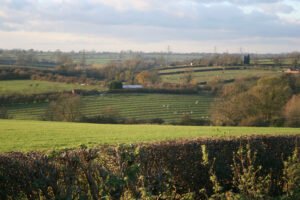
The colour photograph showing English Farmland there is a hedge in the foreground which has been trimmed with the mechanical hedge trimmer behind the hedge is a field with known grass various hedge rows seen in the distance and small farm building with silver roof this is galvanized corrugated steel in the fields are sheep and cows and in the distance there are two Cyprus trees and the very far distance you can see a lime of electricity pylons of style built in the 1970s which include galvanized steel lattice work and Carry approximately four to six cables per pile on the sky is overcast with small patches of clear Sky and the center left of the picture there is also a small brick built agricultural building with a single opening visible

Kate Jewell / Farmland near Scalford

BNG Credit Case Study

We will now describe to you a case study involving biodiversity net gain credits: The project consisted of assessing farmland which produces low yields and is hard to manage, and evaluating the current biodiversity value and understanding the ideal habitat to convert the land into. The subsequent increase of biodiversity value that can be gained with the converted land can be equated into Habitat Credits/BNG Credits. These BNG Credits can then be sold for between £9,000 and £25,000 (Squires, 2023).

The ideal habitat to be introduced was Native Broadleaved Woodland, and with 1 hectare of land enhanced from farmland this roughly equates to 5 habitat credits or £45,000.

Added Benefits

The newly planted woodland, funded by a BNG Credit buyer, can also gain additional carbon credits (WCU’s – Woodland Carbon Units). WCU’s can be sold for a guaranteed price for up to 2055/56 and can be sold for any newly planted woodland, not just for BNG.

If you require assistance with BNG Credit evaluation or Carbon Credit Scoping, let us know.

Image: Kate Jewell / Farmland near Scalford