Planning Energy Statement Completed in Leytonstone, Greater London
Southwest Environmental Limited has completed a planning-level Energy Statement for a proposed residential scheme in Leytonstone, Greater London. Commissioned by an architectural firm in London with a rapid turnaround, the technical assessment supports a planning application submitted to the London Borough of Waltham Forest.
Development Proposals and Policy Framework
The proposed development involves the demolition of existing single-storey rear commercial structures and the construction of a part one-, part two-storey building comprising 10 shared living residential units, together with communal kitchen, dining, and outdoor amenity areas. The existing three-storey frontage building is retained.
The assessment was prepared in accordance with statutory national standards and regional and local planning policies, including:
- Building Regulations Approved Document L (2021) and Approved Document O.
- The London Plan 2021 (Policies SI 2, SI 3, and SI 4) and the National Planning Policy Framework.
- London Borough of Waltham Forest Local Plan Part 1 (Adopted February 2024), specifically Policies 85, 86, 87, and 92.
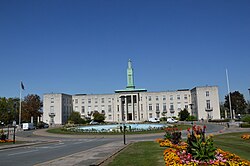
Waltham Forest Town Hall, the local planning authority headquarters for the London Borough of Waltham Forest in Greater London.
Application of the Energy Hierarchy
In compliance with London Plan Policy SI 2 and Waltham Forest Policy 85, the energy strategy follows the four-stage Energy Hierarchy: Be Lean, Be Clean, Be Green, and Be Seen.
Under the Be Lean stage, passive building fabric upgrades reduce thermal space heating demand by 13.6% prior to the inclusion of renewable generation. Specified thermal transmittance values outperform Part L baseline standards, achieving 0.15 W/m²K for external walls, 0.11 W/m²K for ground floors and roofs, and 1.00 W/m²K for windows and glazed doors, paired with a reduced thermal bridging y-value of 0.04 W/m²K and a design air permeability of 3.50 m³/(h.m²) at 50 Pa. Internal and external lighting consists entirely of low-energy LED fittings with daylight and motion sensors.
Under the Be Clean stage, a site appraisal confirmed no active or planned district heat networks within connection distance. To avoid local nitrogen oxide and carbon monoxide emissions, no natural gas connections are proposed, resulting in an all-electric building services strategy.
Under the Be Green stage, space heating and domestic hot water are supplied via Air Source Heat Pumps housed in a screened acoustic plant enclosure, supplemented by shower Waste Water Heat Recovery units that reduce domestic hot water energy demand by approximately 18%. A 3.60 kWp monocrystalline rooftop solar photovoltaic array orientated due south generates an estimated 2,764.80 kWh per year, offsetting 376.01 kgCO2 annually. Sub-metering and smart meters are specified across all 10 units and communal plant circuits to satisfy Be Seen monitoring requirements.
SAP 10.2 Modelling and Overheating Mitigation
Detailed energy modelling was undertaken using Standard Assessment Procedure (SAP 10.2) methodology on a worst-case top-floor corner unit (15.00 m² total floor area). Against a Notional Target Emissions Rate (TER) of 33.91 kgCO2/m²/year, the proposed specification achieves a Dwelling Emissions Rate (DER) of 7.12 kgCO2/m²/year, representing a 79.01% reduction in regulated carbon emissions and a predicted EPC Band A rating (SAP score 112).
To address overheating risk under Approved Document O and London Plan Policy SI 4 without active mechanical cooling, passive measures include openable windows for natural cross-ventilation, deep window reveals with external aluminium shading canopies on south- and east-facing elevations, and exposed brick external masonry for thermal inertia. Please contact us if you would like a fixed price quotation.