Biodiversity Net Gain Assessment for Equestrian Development in South Gloucestershire
Project Overview and Location
Southwest Environmental Limited was commissioned by an individual to prepare a Biodiversity Net Gain (BNG) assessment for a proposed equestrian development in Charfield, South Gloucestershire. The site falls under the jurisdiction of the Stroud District Council planning authority. The proposed development involves the construction of a new horse stable block and the retention of a gravel access track. We completed this ecological reporting with a short lead time to meet the project schedule.
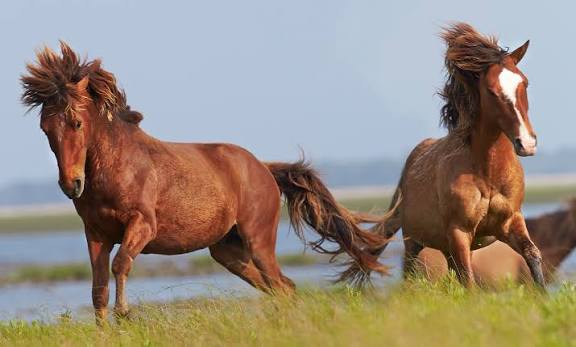
Two energetic chestnut horses gallop and turn sharply through a sunlit summer pasture in France, showcasing their powerful builds as a third horse rests near the wetlands behind them.
Retrospective Baseline Assessment
The site is an established equestrian area historically used for grazing, primarily consisting of modified grassland, an artificial unvegetated wood chip paddock, and native hedgerows[cite: 26, 28]. A gravel access track had been installed across part of the modified grassland without prior planning permission, necessitating a retrospective analysis[cite: 26]. In accordance with Schedule 7A of the Town and Country Planning Act 1990 and statutory BNG guidance, the biodiversity baseline was established using the date of April 2025, which immediately preceded the unpermitted habitat degradation[cite: 26, 30]. By utilising historic satellite imagery alongside current site data, the pre-degradation baseline was calculated at 1.98 Habitat units and 1.20 Hedgerow units using the Statutory Biodiversity Metric 4.0[cite: 27, 35].
Habitat Enhancement and Mitigation Strategy
To achieve the mandatory minimum 10% net gain required for planning approval, a targeted landscape plan was developed focusing entirely on on-site interventions[cite: 27, 32, 35]. The plan mandates the enhancement of 700 square metres of modified grassland from a “Poor” condition baseline to “Moderate” condition other neutral grassland[cite: 32, 35]. This transition will be managed through a specified cutting regime and the introduction of native neutral grassland species to reduce nutrient status and competition[cite: 32]. Additionally, 70 metres of the existing native hedgerow will be enhanced from “Moderate” to “Good” condition using traditional management practices such as hedgelaying and gap planting with native species[cite: 32, 33, 35]. The strategy also includes the planting of four small native trees[cite: 33, 35].
Net Gain Achievements and Long-Term Management
The proposed habitat interventions adhere to the ten good practice principles for BNG, ensuring a measurable contribution to local ecology[cite: 31]. All new and enhanced habitats will be secured under a 30-year long-term management and monitoring plan[cite: 36]. Following the implementation of these measures, the site will deliver 2.20 Habitat units, generating an 11.31% net gain, and 1.33 Hedgerow units, generating a 10.86% net gain[cite: 35, 36]. This output completely satisfies the project’s trading rules and statutory net gain targets[cite: 35]. For further information regarding our ecological planning services, please visit Southwest Environmental Limited.
Please contact us if you would like a fixed price quotation.