Monthly Archives: October 2026

Asked for an “Existing Habitat Appraisal” by North Somerset Council?

If you have recently submitted a planning application to North Somerset Council—or received a validation checklist or pre-application letter—you may have been told that you need to provide an “Existing Habitat Appraisal.”

If you’ve tried searching for that exact phrase online and come up empty-handed, don’t worry. You aren’t missing a brand-new piece of legislation.

At Southwest Environmental Limited, we regularly help homeowners, architects, and developers across North Somerset navigate local planning requirements. Here is a plain-English breakdown of what an Existing Habitat Appraisal actually is, why the council is asking for it, and the most cost-effective way to tick this box for your planning application.

What is an “Existing Habitat Appraisal”?

In short, an Existing Habitat Appraisal is North Somerset Council’s specific wording for a Biodiversity Net Gain (BNG) Baseline Survey (often carried out alongside or as part of a UKHab survey or Preliminary Ecological Appraisal).

Under the mandatory Biodiversity Net Gain rules in England, most planning applications must demonstrate a minimum 10% net gain in biodiversity. However, before you or the council can calculate a 10% improvement, you have to prove what is currently on the site before any ground is broken.

That starting point is your “baseline”—and the assessment of that baseline is what North Somerset Council refers to as an Existing Habitat Appraisal.

What Does the Appraisal Involve?

To satisfy the council’s ecology officer, an ecologist visits your site to map and assess the current land prior to development. During an Existing Habitat Appraisal, we record:

    • Habitat Types: Classifying every part of your site using the UK Habitat Classification (UKHab) system (e.g., modified grassland, native hedgerows, mixed scrub, or developed land).
    • Surface Areas and Lengths: Accurately measuring each parcel of land or linear feature (like hedgerows and watercourses) in hectares or kilometres using GIS mapping software.
    • Habitat Condition: Assessing the ecological quality of each habitat (from “Poor” to “Good”) against strict statutory criteria set by Defra.
    • Protected Species Potential: Flagging any features (such as veteran trees, ponds, or buildings) that might require further protected species consideration.

Can I Complete the BNG Metric Myself if I Have an Existing Habitat Appraisal?

One of the most common questions we get from planning agents, architects, and hands-on developers is: “Can I just pay an ecologist for the Existing Habitat Appraisal, and then fill in the Biodiversity Metric spreadsheet myself?”

The short answer is: Sometimes, yes—especially on small sites—but there are traps to watch out for.

    1. The Small Sites Metric (SSM): If your development qualifies as a “small site” and no priority habitats or protected species are present, you do not strictly need an ecologist to fill out the final Small Sites Metric calculation. However, getting the baseline habitat identification wrong is the number one reason BNG submissions get rejected by North Somerset Council. Having a qualified ecologist conduct your Existing Habitat Appraisal gives you rock-solid baseline data to plug into the metric.
    1. The Statutory (Main) Biodiversity Metric: For larger sites, or sites containing complex/priority habitats, the Defra Statutory Metric must be completed by a qualified ecologist. Furthermore, every habitat requires a technical Condition Assessment sheet, which only an ecologist can reliably produce and defend to a council planning officer.

Our Flexible Approach at Southwest Environmental Limited

We know that every project budget is different. That’s why we offer two straightforward options for North Somerset planning applicants:

    • Option 1: Standalone Existing Habitat Appraisal (Baseline Only) Ideal if you or your planning architect are confident managing the Small Sites Metric yourselves, or if you just need to establish the baseline value of a site before finalising your architectural layouts. We visit the site, classify and map your habitats, complete the condition assessments, and hand over the exact baseline data you need.
    • Option 2: Full Biodiversity Net Gain (BNG) Assessment & Report If you open the Defra metric spreadsheet and decide life is too short for complex ecological trading rules, we can handle the entire process from start to finish. We’ll take our Existing Habitat Appraisal data, overlay your proposed landscaping plans, calculate your post-development biodiversity units, and produce a council-ready BNG Report and Statutory Metric file. (And if you start with Option 1 and change your mind, you can upgrade to the full report at any time!)

Why Use a Local Ecologist for North Somerset Applications?

Every Local Planning Authority (LPA) has its own nuances, validation checklists, and local ecological priorities—from the North Somerset and Mendip Bats Special Area of Conservation (SAC) consultation zones to local Nature Recovery Networks.

Because Southwest Environmental Limited works directly with North Somerset’s planning requirements, we ensure our reports use the exact terminology, mapping standards, and condition evidence that the council’s ecology team expects to see—preventing costly validation delays.
Need an Existing Habitat Appraisal? Get a Fast Quote Today

Don’t let planning jargon hold up your application. Whether you need a standalone Existing Habitat Appraisal or a full Biodiversity Net Gain Report in Weston-super-Mare, Clevedon, Portishead, Nailsea, or anywhere across North Somerset, our team is ready to help. Contact Southwest Environmental Limited today with your site postcode and red-line boundary plan, and we’ll provide a clear, fixed-fee quote.

Can AI Write a Flood Risk Assessment? We Tested Automation

Does AI make a cheap Flood Risk Reports, and will it work for Planning?

If you type “Flood Risk Assessment” into Google right now, you will likely see adverts promising reports “From £295”. At the same time, we are constantly told in the press that Artificial Intelligence (AI) can now write complex technical reports in five minutes.

So it is completely reasonable for developers, architects, and landowners to ask: Why does a proper Flood Risk Assessment (FRA) or environmental planning report still cost >£1,400? Why hasn’t AI made these reports cheap?

As a consultancy that actually tests these tools in-house, here is the straightforward truth about what you get for £295, and why AI cannot write a planning-compliant environmental report.

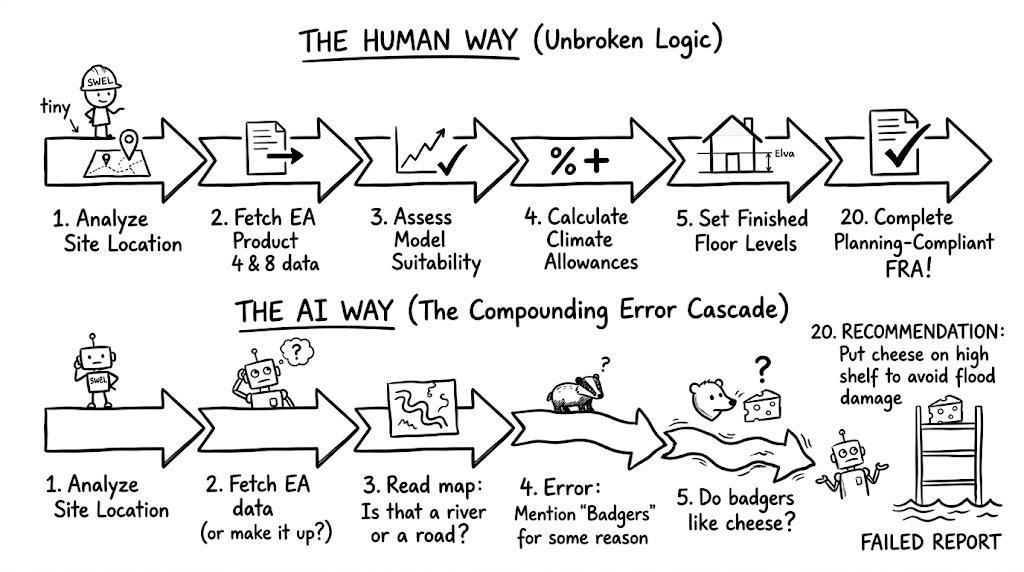
A hand-drawn, black-and-white flowchart diagram contrastingly illustrating the logical 20-step decision-making process of a human-led Flood Risk Assessment versus the chaotic, error-filled path of an AI-led attempt.

How a multi-step logical chain stays on track versus how compounding errors can cause AI to completely miss the mark (and worry about badgers eating cheese).

1. The “From £295” Google Ad Trick

When you see an advert offering a Flood Risk Assessment for £295 or £300, one of two things is happening:

  • It is a lead-capture bait price: In several cases, if you click on a “From £295” Google advert, the £295 price does not actually exist anywhere on the company’s website. Instead, you are directed to a quote form. Once a consultant looks at your site and sees it is in Flood Zone 2 or 3, or requires a Sequential Test, the real quote comes back in four figures.
  • It is an automated map printout for a low-risk site: Where £300 reports do exist, they are basic desktop screening documents for minor domestic extensions or simple Flood Zone 1 validation checks. They pull free, open-source maps from the internet and drop them into a pre-written template within 48 hours.

If your site is in Flood Zone 2 or 3, a £300 template report will not get you through planning. A site-specific Flood Risk Assessment requires ordering and reviewing Product 4 data and breach hazard models directly from the Environment Agency (which takes up to 20 working days to arrive), checking whether the underlying hydraulic model is still fit for purpose, setting accurate Finished Floor Levels, and preparing a Flood Warning and Evacuation Plan or local Sequential Test. None of that is included in a £300 fee.

2. We Tested AI Automation—Here Is Why It Fails on Reports

We are not anti-technology at Southwest Environmental Limited. In fact, I recently spent a significant amount of time setting up an autonomous AI system on a Linux machine in our office to test what it could reliably handle.

Before letting it anywhere near an environmental report, I gave it what should have been a very simple office task: watch an email inbox for an invoice trigger, read the matching row from a spreadsheet, and place those five pieces of text onto fixed points on a PDF invoice.

It failed repeatedly. In fact, it got that basic task wrong in so many different ways that I eventually pulled the plug on it.

The reason it failed highlights a major flaw in current AI models: they are reasonably accurate at answering one single question at a time, but they fall apart when a task requires a long chain of decisions.

Writing a Flood Risk Assessment or a Phase 1 Desktop Study is not a single question. It is a chain of 20 to 30 linked technical judgements. A human consultant has to look at historical Ordnance Survey maps, read Environment Agency flood depth and flow data, check LiDAR ground contours, spot a culverted watercourse behind a railway embankment, and work out how water will actually flow across a specific plot of land.

Current AI cannot reliably read engineering maps or spatial data, and if it makes a small mistake at Step 2 of a 25-step chain, the final flood mitigation advice at Step 25 is completely wrong. When hundreds of thousands of pounds of land value or development costs ride on a planning application, “mostly right” is useless.

3. Planning Officers Don’t Want a Sci-Fi Novel

There is another problem when people let AI loose on a full report: the tone of voice. Left to its own devices, AI writes like a bad sci-fi novel. It stuffs paragraphs full of dramatic words and strange phrases that no UK engineer or planner actually uses.

Local Planning Authority case officers and Environment Agency consultees do not want dramatic adjectives. They want flat, plain, accurate facts: exact flood levels in metres Above Ordnance Datum (m AOD), clear surface water drainage calculations, and a sensible argument showing how the design meets national and local planning policy.

4. Where AI Actually Helps (And Where Humans Are Still Required)

While AI cannot write a full report from scratch without making a mess of it, it is genuinely useful when kept on a short leash and steered by a human consultant. At SWEL, we find it works well for two specific things:

  • Processing raw datasets: Quickly sorting or formatting large tables of environmental or hydrological data.
  • Checking policy updates: Reviewing individual report sections to flag where national guidance or planning policy paragraph numbers (such as the August 2026 NPPF updates) have changed.

Even then, any time saved on admin is quickly eaten up by rising regulatory complexity—whether that is Biodiversity Net Gain (BNG) metric calculations, Preliminary Ecological Appraisals (PEAs), Phosphate Assessments, or stricter surface water drainage rules.

The Bottom Line

If your project is a simple house extension in a low-risk area, a cheap screening report might be all you need. But if you are submitting a planning application on a complex site or in a higher-risk flood zone, there is still no substitute for an experienced human consultant reviewing the data, making a reasoned professional judgement, and standing behind the report with full Professional Indemnity insurance.


Need a Straightforward Quote for a Planning Report?

Whether you need a Flood Risk Assessment, Sequential Test, Desktop Study, or Phosphate Assessment, contact Southwest Environmental Limited with your site postcode and planning details. We will tell you plainly what your local authority requires and give you an honest price for the work.

Call our regional offices for a free initial discussion: Bristol (01173 270 092) | Exeter (01392 927 961) | London (02076 920 670) | Manchester (01612 970 026)

Net-Zero Astroturfing: A Tiny Core of X Accounts Manufacture Over Half Of Backlash

The 2026 UK Net-Zero Astroturf Benchmark: How a Tiny Core of X Accounts Manufactures Over Half of Green Brand Backlash

Published by Southwest Environmental Limited (SWEL) | October 2026

Whether you are rolling out domestic heat pumps, consulting on a new solar farm or Battery Energy Storage System (BESS), expanding the UK’s EV charging network, or trialling methane-reducing dairy feed, the story on X (formerly Twitter) often looks the same: an overwhelming wave of public anger, boycotts, and local planning objections.

For corporate communications directors, ESG leads, and renewable planning teams, this hostility creates real commercial damage. Retailers get nervous about consumer boycotts, fleet partners question EV reliability, and local councillors mistake noisy social media comment sections for genuine community consensus.

To test how much of this backlash is genuinely organic, our narrative intelligence team under SWEL’s Green Brand Guard suite conducted a series of 72-Hour Baseline Forensic Sweeps across five major UK net-zero sectors (evaluating over 1,700 external posts). By stripping out official brand accounts and industry trade bodies, and analysing reply latency, timestamp patterns, and handle structures, we uncovered a stark mathematical reality: between 37% and 62% of all “public” hostility is manufactured by a tiny, repeating core of notification campers, automated scripts, and burner sockpuppets.

The 2026 UK Green Sector Swarm Benchmark (72-Hour Telemetry)

Below are the anonymised aggregate findings from our October 2026 forensic sweeps across five leading UK sustainability brands and infrastructure developers:

UK Green Sector External Posts Swept (72h) Pareto Swarm Concentration Persistent Campers (3+ Hits) Numeric Burner Sockpuppets Commercial Spillover Accounts
1. Domestic Clean Energy & Heat Pumps 488 posts (256 posters) 56.6% of volume (from 74 accounts) 38 accounts (47.3% of all chatter; top camper: 28 hits) 5 accounts (7.6% of volume) 24 accounts crossing from policy to customer support
2. Green Energy Founder & Retail 614 posts (474 posters) 24.3% of volume (from 46 accounts) 21 accounts (12.2% of volume) 16 accounts (8.8% of volume; top burner: 12 hits) 12 accounts crossing from founder to retail brand
3. Sustainable Dairy & Methane AgTech 172 posts (135 posters) 37.2% of volume (from 34 accounts) 10 accounts (20.9% of volume; top camper: 5 hits) 4 accounts (5.8% of volume) 7 accounts bridging conspiracy tags into retail handles
4. UK EV Charging Infrastructure 239 posts (146 posters) 62.3% of volume (from 69 accounts) 17 accounts (36.8% of volume) 4 accounts (3.8% of volume) 2 accounts crossing from ideological to brand threads
5. Grid, Solar & BESS Planning 236 posts (137 posters) 60.0%+ of volume driven by repeat amplifiers 15 accounts generating over 38% of project noise High-density link & hashtag amplifiers 7 accounts linking national wedge issues to local sites

Three Critical Patterns Every Green Comms & Planning Team Should Know

1. The “Notification Camper” Illusion (47.3% of Volume from 38 Accounts)

In our audit of a flagship UK clean energy and heat-pump provider, well over half of all external chatter (56.6%) came from just 74 repeat accounts. Even more remarkably, 47.3% of the entire 72-hour conversation (231 out of 488 posts) was generated by just 38 “Persistent Notification Campers”—led by a single redacted account (@notn***77) that hit the brand and its founder 28 times in three days.

When executives or journalists scroll through those replies, it feels like a nationwide consumer revolt against heat pumps and smart meters. In reality, removing fewer than 40 obsessive repeat offenders cuts the hostile noise in half overnight—without silencing a single genuine customer asking for billing or meter support. Learn how our Executive Social Shield & Surgical Bot Blocklists isolate these accounts safely.

2. Synthetic Boycotts & ESG Disinformation Swarms

When a major UK dairy cooperative trialled methane-reducing feed additives, online boycott hashtags spiked immediately. However, our 72-hour forensic sweep revealed that 37.2% of the external volume was driven by just 34 repeat accounts, dominated by 24 high-density URL, hashtag, and dogwhistle-emoji amplifiers alongside auto-generated numeric sockpuppets. By separating synthetic amplification from genuine consumer questions, sustainability teams can provide supermarket buyers and institutional investors with hard data proving that a “boycott” is largely manufactured. See our ESG Disinformation Due Diligence & Takedowns briefing for more details.

3. National Astroturfing in Local Renewable Planning Consultations

For onshore wind, utility-scale solar, BESS, and grid transmission developers, social media hostility isn’t just a PR headache—it delays planning consent. National anti-pylon and BESS-fire networks routinely monitor local developer handles and planning announcements, flooding threads with links and hashtags to make local opposition appear overwhelming. SWEL packages 72-hour and 30-day telemetry into formal Renewable Planning Consultation Astroturf Audits, giving Development Consent Order (DCO) and TCPA planning teams evidentiary appendices that distinguish genuine local residents from national repeat-camper swarms.

Quick Glossary: Plain-English Guide to Bot & Astroturf Forensics

  • Pareto Swarm: A tiny group of repeat accounts creating the majority of your online noise to make opposition look widespread.
  • Notification Campers: Obsessive accounts (posting 3+ times in 72 hours) that sit on your feed waiting to hijack every announcement.
  • Numeric Sockpuppets: Throwaway burner accounts with default auto-generated number handles (e.g., @Name12345678) spun up to fake crowd outrage.
  • Sub-15s Loop / Sniper Scripts: Automated bots that reply faster than a human can type to grab the top comment spot under an executive’s post.
  • Astroturf Amplifiers: Accounts stuffing replies with external links, campaign hashtags, or dogwhistle emojis (🤡, 🚨, 🐑) to game the algorithm and manufacture fake grassroots (“astroturf”) backlash.
  • Commercial Spillover: Trolls crossing over from attacking executives on net-zero policy to spamming your main commercial brand or customer support handles.
  • Surgical author_id Blocklist: A list of permanent, hidden numeric X account IDs. Because an author_id never changes—even if a troll changes their @username—your social team can mute confirmed bots and repeat campers in one click without ever blocking a real customer.

Request a Private 72-Hour Baseline Audit for Your Brand or Project

You don’t need an expensive, five-figure enterprise SaaS subscription to find out who is brigading your social channels or planning consultation. Explore our full Green Brand Guard suite or contact the SWEL team today to request a private 72-Hour Baseline Forensic Sweep & Surgical Blocklist CSV for your executive, brand, or renewable infrastructure project.

Bespoke Environmental Permits for Campsites on Sensitive Aquifers

Navigating Bespoke Environmental Permits for Campsites on Sensitive Aquifers

Operating a thriving campsite or holiday park comes with significant environmental responsibilities, especially when your site sits above a sensitive groundwater zone. We recently consulted on a case for a high-capacity campsite operating over a Secondary A aquifer with an archaic septic tank and soakaway system. Because the site generates well over the 2,000-litre daily threshold, it falls entirely outside the General Binding Rules, requiring a complex bespoke environmental permit.

If you are managing a large off-grid site, here is what you need to know about upgrading your systems, applying Best Available Techniques (BAT), and navigating the complexities of Quantitative Groundwater Risk Assessments.

Why an Old Septic Tank Won’t Cut It

A septic tank only provides primary treatment, essentially settling out solids before discharging wastewater. When discharging large volumes of effluent into a highly permeable Secondary A aquifer—which often supports local water supplies and river base flows—primary treatment poses an unacceptable risk of contamination.

To meet the Environment Agency’s (EA) requirement for Best Available Techniques (BAT), sites of this scale are generally forced to upgrade to a modern Package Sewage Treatment Plant (STP). These systems provide active biological, secondary treatment, drastically reducing the pollutant load before it reaches the ground.

The Role of a Groundwater Risk Assessment (GWRA)

Upgrading the hardware is only half the battle. To secure a bespoke permit, you must prove to the EA that your local ground conditions can safely dilute and attenuate the remaining treated effluent. This requires a tiered Groundwater Risk Assessment (GWRA).

Initial assessments often rely on conservative desk studies and shallow trial pit percolation testing. We highly recommend utilizing open-source data early in your planning to understand your site’s baseline sensitivities:

Beware of Scope Creep: The “Baseline” Trap

When budgeting for your permitting process, operators must be prepared for potential scope creep. While a desk-based GWRA combined with shallow soil tests is often accepted, the EA may reject theoretical models if the margins for environmental safety are too tight.

If the EA demands more definitive proof, you may face the following financial and timeline pitfalls:

  • The Demand for Boreholes: You may be required to drill deep groundwater boreholes to establish physical, local baseline conditions and prove the exact hydraulic gradient of the aquifer.
  • 12-Month Monitoring Delays: The EA rarely accepts a single water sample. They may demand up to 12 months of monitoring to capture seasonal groundwater fluctuations before they even process your permit application.
  • Stricter Hardware Requirements: If the groundwater model shows vulnerabilities, the EA might mandate additional tertiary treatment modules—such as UV filtration or phosphorus stripping—significantly increasing your capital expenditure.

Final Thoughts

Expanding a campsite or upgrading an old drainage system over a sensitive aquifer is not a simple paperwork exercise. It requires proactive hydrogeological planning and a phased approach to risk assessment. By understanding the potential pitfalls early, you can budget effectively and ensure your site remains compliant and environmentally responsible for years to come.

Biodiversity Net Gain Assessment for Equestrian Development in South Gloucestershire

Biodiversity Net Gain Assessment for Equestrian Development in South Gloucestershire

Project Overview and Location

Southwest Environmental Limited was commissioned by an individual to prepare a Biodiversity Net Gain (BNG) assessment for a proposed equestrian development in Charfield, South Gloucestershire. The site falls under the jurisdiction of the Stroud District Council planning authority. The proposed development involves the construction of a new horse stable block and the retention of a gravel access track. We completed this ecological reporting with a short lead time to meet the project schedule.

Two muscular chestnut horses frolic and gallop across a sunny summer field, with a third horse blurred in the distant wetland background.

Two energetic chestnut horses gallop and turn sharply through a sunlit summer pasture in France, showcasing their powerful builds as a third horse rests near the wetlands behind them.

Retrospective Baseline Assessment

The site is an established equestrian area historically used for grazing, primarily consisting of modified grassland, an artificial unvegetated wood chip paddock, and native hedgerows[cite: 26, 28]. A gravel access track had been installed across part of the modified grassland without prior planning permission, necessitating a retrospective analysis[cite: 26]. In accordance with Schedule 7A of the Town and Country Planning Act 1990 and statutory BNG guidance, the biodiversity baseline was established using the date of April 2025, which immediately preceded the unpermitted habitat degradation[cite: 26, 30]. By utilising historic satellite imagery alongside current site data, the pre-degradation baseline was calculated at 1.98 Habitat units and 1.20 Hedgerow units using the Statutory Biodiversity Metric 4.0[cite: 27, 35].

Habitat Enhancement and Mitigation Strategy

To achieve the mandatory minimum 10% net gain required for planning approval, a targeted landscape plan was developed focusing entirely on on-site interventions[cite: 27, 32, 35]. The plan mandates the enhancement of 700 square metres of modified grassland from a “Poor” condition baseline to “Moderate” condition other neutral grassland[cite: 32, 35]. This transition will be managed through a specified cutting regime and the introduction of native neutral grassland species to reduce nutrient status and competition[cite: 32]. Additionally, 70 metres of the existing native hedgerow will be enhanced from “Moderate” to “Good” condition using traditional management practices such as hedgelaying and gap planting with native species[cite: 32, 33, 35]. The strategy also includes the planting of four small native trees[cite: 33, 35].

Net Gain Achievements and Long-Term Management

The proposed habitat interventions adhere to the ten good practice principles for BNG, ensuring a measurable contribution to local ecology[cite: 31]. All new and enhanced habitats will be secured under a 30-year long-term management and monitoring plan[cite: 36]. Following the implementation of these measures, the site will deliver 2.20 Habitat units, generating an 11.31% net gain, and 1.33 Hedgerow units, generating a 10.86% net gain[cite: 35, 36]. This output completely satisfies the project’s trading rules and statutory net gain targets[cite: 35]. For further information regarding our ecological planning services, please visit Southwest Environmental Limited.

Please contact us if you would like a fixed price quotation.