Category Archives: Lighting Assessment

Lighting Assessment for Residential Development Near Woodland Habitat

Lighting Assessment for Residential Development Near Woodland Habitat

Southwest Environmental Limited was recently instructed by an architectural firm to produce a Lighting Assessment for a proposed residential development. The site is located in Buckland Ripers, Dorset, and falls within the planning jurisdiction of Dorset Council.

The Development

The proposed development comprises the construction of a single residential dwelling, a garage, and an associated garden. Environmental constraints were a primary consideration for this site. The location is situated 1.6 kilometres from the Dorset National Landscape Area of Outstanding Natural Beauty (AONB). Furthermore, a woodland area is located just over 20 metres to the south of the proposed dwelling. Ecological surveys previously conducted at the site identified the presence of Myotis bats within this woodland. Myotis bats are known to be highly sensitive to artificial light, necessitating careful planning and mitigation.

Objectives

The objective of our Lighting Assessment was to design a lighting scheme that meets the safety and operational requirements of the future human occupants while preventing light spill that could negatively impact the adjacent bat habitat. The assessment was conducted in accordance with relevant legislation, including the Planning (Clean Neighbourhoods and Environment) Act 2005, and national planning policies which require new developments to limit the impact of light pollution on nature conservation.

To achieve the necessary control over light emission, we developed a strategy adhering to the guidelines set out by the Institute of Lighting Professionals and the Bat Conservation Trust. External lighting is restricted to narrow-beam, horizontal cut-off LED downlighters mounted at low elevations, specifically 0.6 metres and 1.6 metres above ground level. These luminaires will be fitted with passive infrared (PIR) and dawn-to-dusk sensors to ensure they are only active when required. We specified a warm colour temperature range of 2700k to 3000k to minimise the ultraviolet light output, which is known to attract insects and disrupt bat foraging patterns. Up-lighting was strictly prohibited across the entire site.

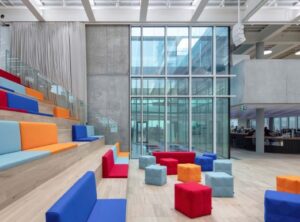
A bright, modern lecture space with large windows and colorful blue, yellow, and red tiered seating.

A Well Lit Space

Internal light spill was also evaluated as a critical factor due to the proximity of the southern woodland. To address this, the design incorporates electrochromic glass on the windows of the front entrance. This dynamic glazing activates when internal lighting is switched on, providing up to a 90 percent reduction in visible light transmission through the glass.

Method & Outcome

We utilised lighting design software to model the proposed external and internal lighting, producing lux contour plans for both horizontal and vertical planes. The quantitative analysis demonstrated that horizontal light spill on the ground would remain below 0.5 lux around the immediate development, dropping below 0.2 lux well before reaching the woodland edge. Vertical luminance along the woodland boundary was also shown to be predominantly below 0.2 lux, ensuring the bat habitat remains sufficiently dark. Construction phase mitigation measures were also detailed to prevent temporary light spill during the build.

This comprehensive analysis and the accompanying mitigation strategy were completed with a short lead time to assist the client in maintaining their planning submission schedule.

Please contact us if you would like a fixed price quotation.
Lux Contour Plan for Planning Application – Somerset (BS40)

Lux Contour Plan for Planning Application – Somerset (BS40)

We’ve recently carried out a lighting assessment and lux contour plan for a site in North Somerset.

Lux Contour Plan

The development was for a single dwelling within a village and included various external light fittings it was thought that these may impact on bat habitat around the circumference of the site and as such the planning officer asked for a lighting assessment to be carried out part of the lighting assessment involves reduction of a 3D computer model which is necessary in order to create a Lux contour plan.

The level intensity of light at the edge of the site should be below 0.2 Lux and we’re happy to report that this was the case at this site with use of light fittings that do not create a large amount of spill.

If you need a lighting assessment or lux contour plan, please contact us.

Lux Contour Map & Light Spill Assessment – Chelsea, London

Lux Contour Map & Light Spill Assessment – Chelsea, London

Earlier this month we were commissioned to write a light spill assessment for a residential project in Chelsea, London the project involved modeling a site that was undergoing refurbishment & redevelopment, and observing the light spill given a specific set of internal and external light fittings.

Image showing a 3D model of a building and the lights spill which is emanating from the glazed facade the spill is shown as contours labeled with Lux values and false Color has been applied to the contour lines in shades of pink purple and blue to share the intensity of the lights spill

Lux Contour Modelling

We were able to model a three-story building with extensive glazing overlooking a rear courtyard the internal lighting intensity was set an acceptable Lux level and the glazing apertures were accurately placed so as to show spill into the rear Courtyard they’re also some windows from Neighboring properties overlooking Courtyard.

We also created simple building layouts for these neighbouring buildings and examined the lights bill into the bedrooms assumed of these Neighboring properties we’re able to show with the model that the lights belt into the bedrooms was below one Lux which is considered a criteria for sleep disturbance.

Lighting design has advanced considerably in the last decade, and the variety of beam shapes available are mind boggling, with an asymmetric beam shape you can place fittings close to a boundary, and limit light spill into neighbouring property.

Some manufactures publish very detailed data for their light fitting which enable us to model them accurately. If you are looking for light fittings of a specific type then please ask us, as we have seen 100’s of types over the years, although for ecological lighting design we do have our favourites.

If you need a slight spill assessment or a lux contour plan (or both!) then please contact us for no-obligation chat, and fixed price quotation.


What are the Different Types of Light Pollution?

What are the Different Types of Light Pollution?

There are a number of different types of light pollution, each one is slightly different and in term sof the negative effect it has on the environment.:

1 – Light Spill

Light spill is quite a generic term, and is usually used in the context of artificial light that “spills” from a light source in to an area where it is not wanted.

This might include say a new flood light on the side of the building shining in to someone bedroom window.

Light spill can come from external lights, or it can been spilt out of windows.

Flood Light Mounted on a Brick Wall

2 – Glare

This is more to do with the intensity of the light source. Modern LED lights can give off a lot of glare, because the emitters are very small and very bright.

So for example, the glare from lights in a petrol filling station, if not designed correctly may emit a glare that is troublesome to nearby road users.

Glare can also be caused by reflected sunlight off a reflective build facade.

Glare from a street lamp

3 – Sky Glow (Dark Skies)

Light can spill upwards into the sky causing a phenomenon known as sky glow. This creates a glow in the sky, reducing the contrast between stars and the sky. In “dark sky areas” often there is a requirement for specific lighting design.

Flood Lights Facing Up Lots of Sky GLow Created

4 – Ecological

Light can influence the behaviour of insects. Other creatures feed on insects, and so there is an indirect impact. For example in areas where bats eat insects, lighting design should spill no more than 0.2 lux on to trees or the ground.

Insects are Attracted to Light, Modifying Behaviour of Predators

Services we Offer

We can provide:

  • Light Spill Assessment for Bats
  • Lighting Assessments for Adequate Lighting
  • Dark Skies Assessment
  • Sunlight & Daylight Assessments


Lighting Assessment SSSI

Lighting Assessment SSSI 

SWEL have undertaken a Lighting Assessment in Rickmansworth, the site is to be developed, and lighting impact were required to be assessed. A thorough baseline study was made with a quantitative assessment of spill.

A  twilight survey was made to identify nearby light pollution sources. 

Riveting – Existing light fittings were surveyed. 

The Lighting Assessment Report was published in good time and was well received by the local planning authority.