BRE 365 Soak-Away Report – Brinkworth, Chippenham
![]() |
| Detailed Calculations – To BRE 365 |
![]() |
| BS9530 – Logging of Trial Pits |
![]() |
| Detailed Calculations – To BRE 365 |
![]() |
| BS9530 – Logging of Trial Pits |
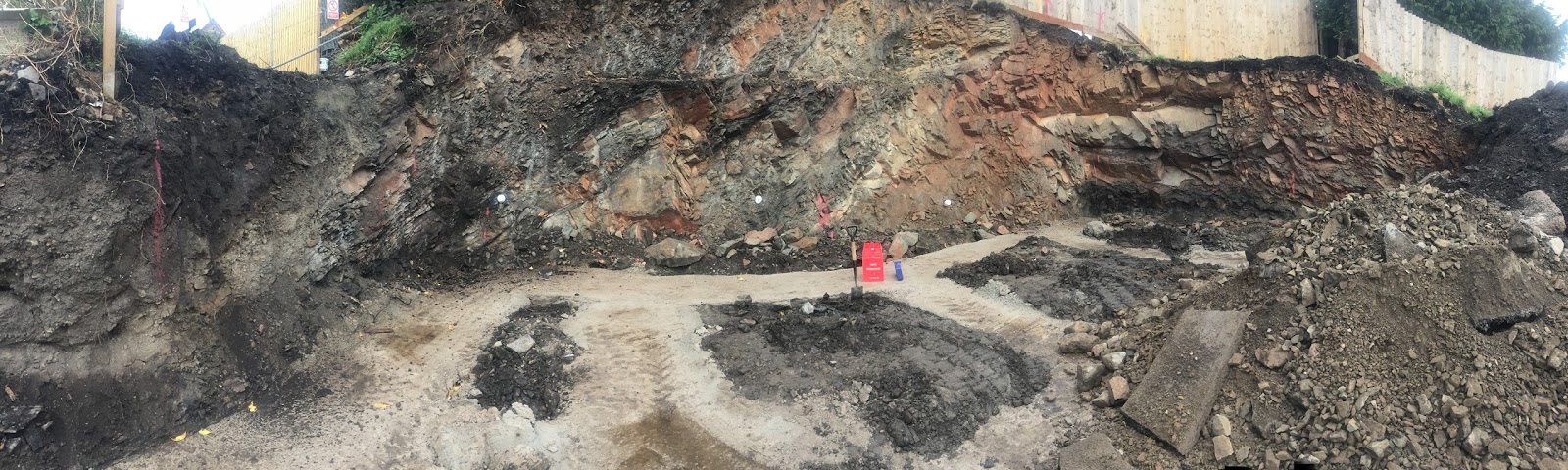
In support of some road stabilisation work SWEL have carried out a geotechnical investigation at Belluton near Bristol.
Despite tight access, drilling works started in a timely fashion, with recovered of some excellent core samples. Holes were advanced to a depth of 15 meters, with dynamic sampling in soils and weathered rocks, and coring in rock proper.
![]() |
| Dynamic Samples from Ground Level in c. 3 Meters Depth |
![]() |
| Core Samples from Weathered Rock Head |
![]() |
| Close Up of Core Fragment |
![]() |
| SPT results and disturbed samples from Soils. |
The investigation is to provide data for a cutting for road widening. The rock seems very competent, but soil nails are proposed for further strengthening. Samples were tested for aggressive ground characteristics, and a variety of classification and strength tests.
Acting Upon instructions from a property developer in Bristol SWEL have assembled a sustainability statement for a multi the residential development win commercial grounds floor use. The development incorporates large areas of south facing glazing and as such specific concerns were raised by Bristol City council regarding overheating potential mitigating measures such as
Overhanging shading were stipulated as possible future upgrades these future upgrades were included within plans with space left for them to be added as a future date when and if some overheating becomes a problem.
Bristol City council have recently started to require detailed energy Modeling at the planning stage SWELconducted a whole building energy model for the development which allows for the presentation of building energy demand and the subsequent : savings achieved through efficiency and renewable energy measures.
Sustainability Energy Statement Bristol
Acting on instruction from a property managment company SWEL have produced a desktop study for a property in Chittening, Bristol.
The property lease was to be aquired by a company and as good practice they were keen to establisg risk from ground contamination in a qualified manner.
SWEL have visited site, photgraphed the building internally and externally, we then use up to date environmental data from the Bristol area and mapping to draw qualified conclusions with regards to ground quality on site.
In this instance we felt that although the build could have had a number of uses, that risk to future users was low owing to broken exposure pathways, and the nature of the intended use.
Acting on instruction of a property developer SWEL have produced a Sustainability Statement for a site in Lyppiatt Rd, Bristol. The site is a mixed use development incorporating residential and commercial spaces.
The project has a highly fragmented roof, and options were explored to perhaps use combined heat and power in order to provide emissions savings in line with BCC Policy BCS 14, which requires that a carbon reduction of 20% is achieved beyond building regulations.
Other Bristol City Council Sustainability Policies include:
BCS13: Climate Change – Requires development to both mitigate and adapt to climate change.
BCS14: Sustainable Energy – Provides criteria for assessing new renewable energy schemes, with a presumption In favor of large‐scale renewable energy installations.
Requires new development to minimise its energy requirements and then incorporate an element of renewable energy to reduce its CO2 emissions by a further 20%. Supports the delivery of a district heating network in Bristol.
BCS15: Sustainable Design and Construction – Requires all developments to engage with issues around sustainable design and construction.
As with London Sustainability Statements, Bristol City Council also require that the energy hierarchy is followed :
Southwest Environmental Limited were commissioned to undertake a site waste management plan for a site in Enfield London N13.
The project was or considerable scale with numerous residential units built on a brown field site. The report amongst other chapters considers the following:
2.1 Demolition Waste
2.1.1 Demolition Wastes
2.2 Excavation Wastes
2.2.1 Excavation Waste Types Forecast
2.2.2 Excavation Waste Quantities Forecast
2.3 Construction Wastes
2.3.1 Construction Waste Types Forecast
2.3.2 Construction Waste Quantities Forecast
![]() |
| The Waste Hierarchy |
The report follows the waste hierarchy and aims to minimize disposal to landfill. During the construction phase the SIte Waste Management plan makes recommendations as to good working practice that can reduce wastes. Suggestion such as:
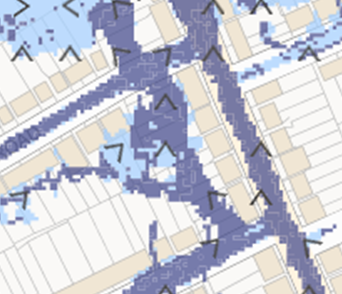
SWEl have recently prepared a Flood Risk Assessment for an interesting proposed development in Merton (New Maldon).
The development sees the retention of a existing building for conversion under PD rights, and the creation of e neighbouring residential unit.
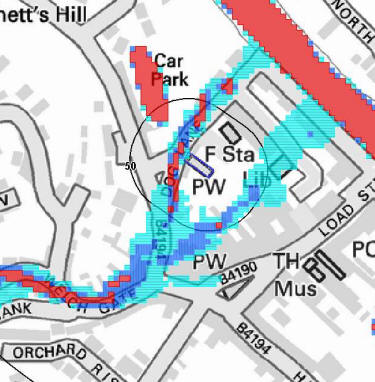
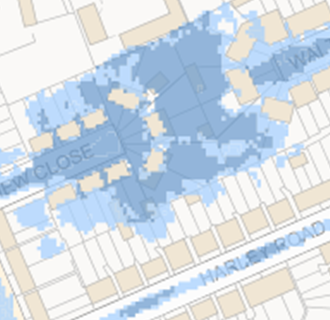
Below images show various mapping used in the compilation of the report.
![]() |
| Flood Extent Mapping in Merton |
![]() |
| Model Nodes used in 2D Models |
![]() |
| A Considerate Design improves Planning Success |
Southwest Environmental Limited have recently prepared an Odour Management Plan for a Nail Bar in Crawley, Sussex. The salon type establishment was sited within a busy shopping precinct. Our client had been requested by his local council to provide an odour management plan.
We were asked to prepare this document on a 3 working day turn around which we were just about able to do. We referenced industry codes of practices and focussed on the main causes of odour such as vapours and dust.
The odour management plan is a working document, and we aim to write such a report as simply as possible, with useful forms and survey checklists included for easy reference.
Acting on instruction from a client based in the greater London area, SWEL are to prepare an Odour Impact Assessment for a Anaerobic Digestion (AD) Plant in Devon.
The Anaerobic Digestion Plant is to use agricultural feed stock in to produce gas, and ultimalty genrate electrcial energy vis the use of gas engines to feed in to the grid.
As solar and wind capacity increases and base load capacity decreases, the UK must fill the gap. Anaerobic Digestion Plants offer the possibility of storing gas produced, and generating power when it is needed.
![]() |
| Odour Modelling |
The odur impact assessment was conducted using odor concentrations derived from secondary sources, in the most part peer review scientific papers. These values were then used in a model to derive am odour concentration at near by receptors.
The model used was aeromod, which is the preferred modelling system used in the UK and USA. In fact the model was produced in the USA, by their equivalent of the Environment Agency the EPA.
The model works, by caluclating dispersion, and also “averaging” out plume concentrations based on wind directions. There are various parameters that can be changed, in cluding atmopshric stibility etc.
Owing to the comparatively low odor emissions from the proposed agricultural feed stock the odour impacts are very low.
SWEL can conduct Odour Impact Assessments on a quick turnaround and also offer odour modelling services, to air quality professionals.