Category Archives: Flood Risk Assessment

Flood Risk Assessment – Bristol

Flood Risk Assessment – Bristol

SWEL were recently commissioned to undertake a flood risk assessment in Bristol. This site is an interesting one in terms of settings. As is resides within some characterful gardens walls, which have a curved to match the site boundary.

A Pub near the Site

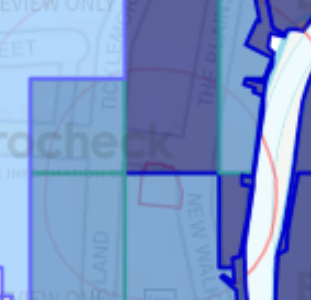
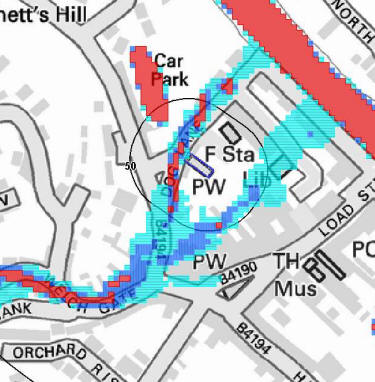
The key as always with a good flood risk assessment is collecting a wide selection of data to characterize flood risk at the site. 3rd party data reveled flooding of significant depth on site, whilst the Environment Agency data from neighboring sites showed details that will aid in the design of the building.

The report also includes exceptions test, sequential test and surface water recommendations.

Flood Risk Assessment Kent

Flood Risk Assessment Kent

SWEL were instructed to undertake a Flood Risk Assessment for a proposed development in Romney Marsh, Kent. For a Residential Development.

The scheme saw the construction of 2 homes, on a site occupied by a dilapidated bungalow.

A Wider Variety of Flood Risk Data was Used to form an Opinion

Key the flood risk assessment was establishing the level of protection afforded by the coastal defenses in the area, we arranged to have data supplied on the sea defenses which showed they were in good condition and that they were gave an applicable protection level.

Advise was included on required attenuation volumes, and any special construction techniques.

The sequential test was a key part of the report. We include a sequential test in our flood risk assessment as standard. . .if it is required.

Flood Risk Assessment – Catford SE6

Flood Risk Assessment – Catford SE6

Southwest Environmental Limited were commissioned by a client to undertake a Flood Risk Assessment at a site in South East London.

The project was for conversion of a basement to living quarters. This is usually one of the more difficult situation to get passed off with the Environment Agency (as consultees in planning) as a flooded basement is not a very good thing / situation:

  • It is hard to dry out.
  • It is hard to get flood data (most relates to ground level).
  • Hard to prove people will be safe.
All these things / factors  stack up against the normal bunch / collection of criteria / things that must be met to satisfy both the Environment Agency and the Local Planning Authority. 
In this instance there was a slight advantage as the basement on this site was more akin to a lower ground floor, being open on 3 sides, only being below ground level on the street frontage. 
However, it has still been necessary to make a detailed study of  site levels relative to the flood levels. Only in this way can SWEL provide mitigation measures when considering the risk involved. 

3 Flood Risk Assessments for DEFRA

3 Flood Risk Assessments for DEFRA

Commissioned via a 3rd Party Southwest Environmental have recently been working with DEFRA at one of their sites close to London. SWEL have produce 3 Flood Risk Assessments in support of 3 planning applications.

It should be noted that despite working for NGOs and Multi-Nationals we still accept commissions from individuals and companies of any size.

The reports were produced on a very quick turnaround and contained all required information plus design advice and surface water management information.

A Random Flood Map which is Not of the Study Site

The projects sites were within Zones 1 2 and 3, with varying levels of flood risk. The projects also carried various levels of vulnerability and this was taken into account when authoring the reports.

In one instance feedback was given at an early stage with regards to design requirements to mitigate against flood risk, this was provided within 48 hours of commissioning and the information was relayed to the design team ahead of draft plan issues.

Flood Risk Assessment – Harrow

Flood Risk Assessment – Harrow

Southwest Environmental Limited have recently prepared a Flood Risk Assessment for a site in London.

The site was in flood zone 1, and was under the area (1 hectare) that would ordinarily trigger the requirement for a Flood Risk Assessment.

It was our opinion that the Flood Risk Assessment was requested because the site is:

  • A risk from surface water flooding.
  • Includes a basement. 
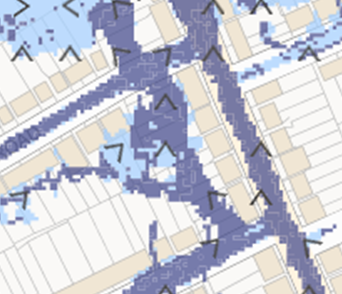
Surface Water Flow Velocity
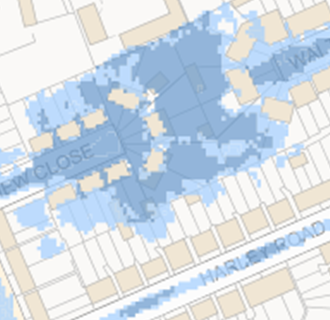
Surface Water Depth

The report recommended that as long as a few simple measures were adopted such as:

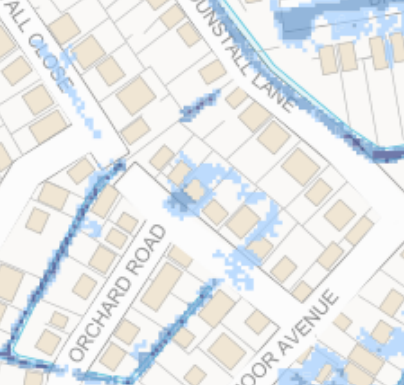
There is surface water flooding highlighted as close to site of the extension and basement. Careful consideration will have to give to the avoidance of flow path creation. For example: the ground level at the rear of the building should be maintained so as to prevent surface water flowing towards the rear of the house. This would include depressions created for external stairways. An up an over stair crest may be required to maintain this level.

Removable flood boards should be fitted in all external doorways, up to a height a 50cm above threshold. Levels (front threshold + 50cm) should be matched at rear of property for stair crest.

Flood resilient construction should be used in basement level (see below table). Clear access should maintain from basement to ground floor level. New External and Internal Doors should hinge inwards.

Centralised service nodes such as boilers and consumer units should be situated on the ground floor level. 

3 x Flood Risk Assessment – Bridgwater & Highbridge

3 x Flood Risk Assessment  – Bridgwater & Highbridge

Southwest Environmental Limited were commissioned for a “job lot” of 3 Flood Risk Assessment within Sedgemoor District Council Administrative Area.

The flood risk assessments were prepared on a rapid turnaround, provided with practical advice for the design response and resilience measures.

A good report needs good data.

Flood Defenses in the Area are not great.

Flood depths exceed flood defences.

The three projects were conversions of existing buildings and parts of buildings fro use as residential dwellings. These conversion add a constraint to the design in that often one can not extend outside the envelope of the existing building.

This becomes problematic when flood water depth is much above 50cm, as raising of floor level beyond this height is often impractcial and so other solutions have to be offered up.

Flood Risk

Flood Risk Assessment – Exeter

Flood Risk Assessment  – Exeter

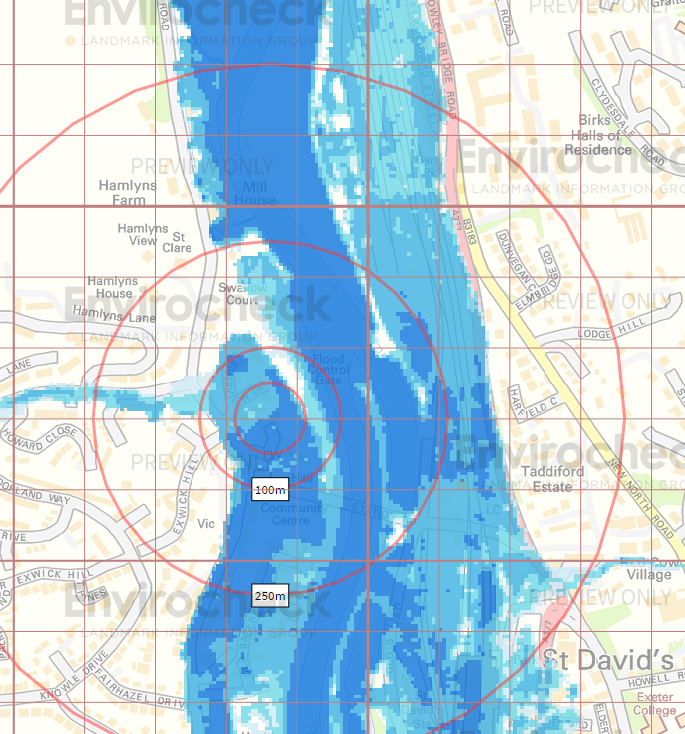
Southwest Environmental Limited have recently carried out a flood risk assessment for a site in Exeter, Devon. The site was very close to the river exe flood relief channel and as such it was important to establish whether it was indeed possible to build a dwelling at the location that would:

  1. Mitigate Against Flood Risk 
  2. Remain in Keeping with Surrounding Buildings
The problem is that is flood depths are too great then a building ground floor use may have to be limited to no residential use. If neighbouring buildings are “normal” houses then the proposed structure may look out of place, and this can cause problems when in planning .
Topography Indicates a Level Area

The Site is Well Within Flood Zone 3

Flood Depths were Fairly Deep on Site
In this instance SWEL were to prepare a report to set before the Environment Agency for scrutiny outside of formal planning. In this way we can check that the project is viable from a flood risk point of view prior to proceeding with planning proper and all the extra time and expense that that involves. 

Flood Risk Assessment – Dorset

Flood Risk Assessment – Dorset

Acting on instruction from an architects in dorset, SWEL have been commissioned to carry a flood risk assessment, for a barn conversion.

Flood Risk to Barn Conversion

The flood risk assessment will be based on third party data, which will indicate flood depths in the area, and these flood depths will be used to inform decisions relating to finished floor level and safety of occupants.The flood risk assessment will be submitted to North Dorset District Council, who will be required to present the report to the Environment Agency as statutory consultees.

All being well, the EA will agree with the content of the report, and they will not raise an objection. The project will not be subject to the sequential test as it is a conversion.

Flood Risk Assessment

Flood Risk Assessment for Hotel – Bristol

Flood Risk Assessment for Hotel – Bristol

Acting on instructions from Global Client Southwest Environment have undertaken a Flood Risk Assessment for a development site in Bristol, UK.

The project encompassese the retention of a sporting facility and the extension of the facility to include a 55 bedroom hotel and several eateries.

A mixed use development like this is ideal for a site within a high risk flood zone as it allows for low vulnerability uses on ground floors and and high vulnerability uses on the upper floors.

This site however, although surrounded by high risk areas, was at low risk of flooding and also had a convenient escape route in the form of a raised flyover, so as to provide an evacuation route in case of a flood.

Flood Risk Assessment Bristol

Planning Appeal – South Gloucestershire

Planning Appeal – South Gloucestershire

Southwest Environmental were engaged by a individual developer in the South Gloucestershire area. SWEL had previously supplied a Flood Warning and Evacuation Plan, and also a Flood Risk Assessment for the Site.

The planning application was refused on the grounds that the building character was not applicable to the area in which it was built. Which was clearly wrong, as the settlement has not specific character by which to compare the design of the building.

The other point for refusal was the failure of the site to pass the sequential test. Whilst some LPAs release excellent guidance for conducting the sequential test, the LPA in this instance were insisted on preventing the use of our normal assessment criteria (for determining reasonable alternative sites) whilst not suggesting any other criteria by which the site could be assessed!

To lead to a gridlock in the process, and despite us using our standard method for determining the sequential test, which was favourable, and has been widely accepted nationwide for 9 years the application for refused permission.

The appeal has now been lodged backed up by a 1800 word appeal statement, which sets out the grounds for appeal.

Planning Consultants Bristol