
The BNG Small Sites Exemption and the £300k Priority Habitat Trap (August 2026 Update)
As of August 6, 2026, the latest package of mandatory Biodiversity Net Gain (BNG) rules has officially landed. For developers dealing with smaller plots, there is some good news—but it comes with a massive, potentially project-ruining catch if you don’t know what you are looking for on your land.
Here is a practical breakdown of the new exemptions, why you can’t rely purely on desktop maps, and why clearing a site before getting an ecologist out could cost you hundreds of thousands of pounds.
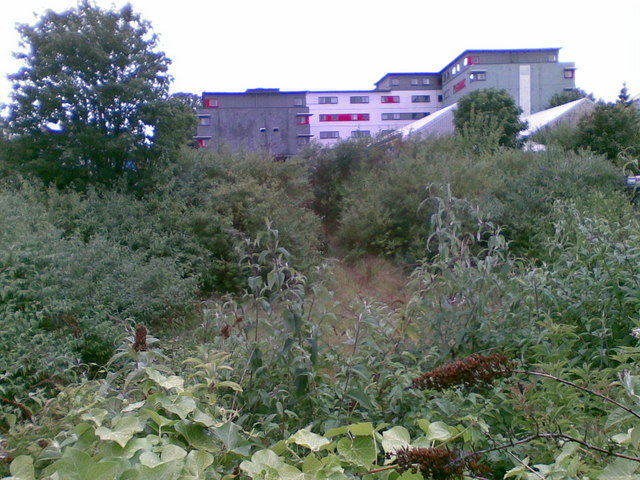
A hilltop educational or office building in Plymouth, standing beyond an overgrown area of scrubland and temporary canvas structures. Image: Alex McGregor CCL
The New Exemptions (As of August 2026)
If your planning application was submitted on or after August 6, 2026, the following updates apply:
- The Small Sites Rule: Developments with a red line boundary of 0.2 hectares (2,000 sqm) or less are now exempt from mandatory BNG.
- Temporary Developments: Fully temporary projects with planning permission for 5 years or less are exempt.
- Self-Builds: The previous exemption for self-build and custom housebuilding has been removed. These must now deliver BNG (though many single dwellings will naturally slip under the new 0.2ha threshold).
- The “De Minimis” Rule: This remains in place, exempting sites that impact less than 25m² of habitat or less than 5m of linear habitat (like hedgerows).
Seems straightforward, right? If you have a 0.15-hectare plot, you’re exempt.
Wrong. There is a major caveat: The small site exemption is immediately voided if the development negatively impacts a UK Priority Habitat.
What is a Priority Habitat?
Priority habitats are ecologically valuable areas protected under the NERC Act 2006. If your site has one, you are disqualified from the small-site exemption. You will need a full biodiversity metric and a bespoke compensation plan.
The three most common priority habitats that catch developers out are:
- Species-Rich Hedgerows: Not your standard hawthorn boundary. If a hedge has five or more native woody species per 30 metres, it’s a priority habitat.
- Lowland Mixed Deciduous Woodland: This covers most native, broadleaved woods in the UK.
- Lowland Meadows: Unimproved, flower-rich grasslands that haven’t been heavily fertilized.
“But it’s not on Magic Map!”
Many developers check DEFRA’s Magic Map, see a blank space over their site, and assume they are clear. This is a dangerous mistake.
Magic Map’s Priority Habitat Inventory is just a desktop tool based on historical data. It frequently misses small woodland copses, edges, or newly matured areas that haven’t been formally surveyed.
For planning and BNG purposes, the local planning authority (LPA) only cares about the ecological reality on the ground today. If your ecologist surveys the site and finds the woodland meets priority criteria, the LPA will legally treat it as priority habitat—regardless of what Magic Map says.
The Pre-emptive Clearance Disaster
Let’s look at a worst-case scenario. Say a developer has a 0.2-hectare site. They check Magic Map, see nothing, and send in the chainsaws to clear a patch of unmanaged trees before putting in planning, assuming they’ll use the small-site exemption.
Later, the LPA asks for an ecological report, and it transpires the cleared trees were actually a priority deciduous woodland.
Here is exactly what happens next under the Environment Act 2021:
1. The “Precautionary Baseline” Penalty You cannot “clear the slate” to bypass BNG. If habitat was cleared after January 30, 2020, the LPA must assess the site based on its condition prior to clearance. Because the physical evidence is gone, the LPA will legally apply a “precautionary approach,” assuming the highest possible distinctiveness and condition for that woodland.
2. The Exemption is Voided Because it was priority woodland, the 0.2ha exemption is thrown out. The developer must deliver a full 10% net gain.
3. The Crushing Financial Cost Let’s run the math on 0.2 hectares of “High Distinctiveness / Good Condition” woodland.
-
It generates roughly 3.6 baseline units.
-
Add the 10% mandatory gain = ~4 units required.
Because the site is now covered in concrete, the developer must buy those 4 units completely off-site.
-
Private Market: High-distinctiveness woodland units currently trade for around £60,000 each. That’s a £240,000 bill.
-
Statutory Credits: If private units aren’t available, you are forced to buy Government Statutory Credits at a penalizing 2:1 ratio. At £48,000 per Tier A2 credit, you need 8 credits. Your final bill? £384,000.
The Takeaway
The BNG rules are designed with heavy punitive measures for habitat clearance. Attempting to bypass the system by clearing a site without professional advice can easily turn an exempt, straightforward build into a six-figure legal and financial nightmare.
Always get an ecologist on site before you touch a single branch.
If you need help navigating the latest BNG exemptions, establishing your baseline, or ensuring your planning application is bulletproof, get in touch with our team today.