
The Great AI Break-Even: When Paying a Human Becomes Cheaper Than the Algorithm
For the past few years, the narrative surrounding Artificial Intelligence has felt like an unstoppable march toward the obsolescence of the knowledge worker. We have all seen the initial magic: a complex dataset that would usually require three hours of tedious Excel formulas and formatting can now be munched through by an AI in seconds, saving hours of professional time.
But as we peel back the artificial interface of the £20-a-month “all-you-can-eat” subscription model and look at the raw economics of enterprise AI, a totally different reality emerges. We are rapidly approaching a fascinating economic transect—a crossover point where the raw cost of AI compute, combined with the fragility of autonomous agents, actually outstrips the cost of simply paying a skilled professional to do the job.
Here is why the widely feared “devaluation of the professional skill set” may be hitting a hard economic ceiling.
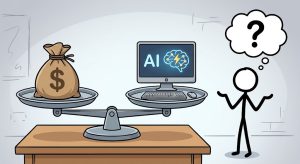
A visual metaphor for the tension between the financial cost of AI and its potential value: even when balanced, the final value proposition remains a question.
The Agentic Illusion and the £100 Paperclip
The current hype cycle is dominated by “agentic workflows”—the idea that you can just give an AI a goal, and it will autonomously plan, execute, evaluate, and finalize the task (Reference: “AutoGPT Explained: How to Build Self-Managing AI Agents”, Built In).
As many developers and business owners have discovered, the reality is far messier. Trying to automate even a seemingly simple, deterministic process—like generating and sending a standard invoice—can quickly become a labyrinth. (For an example of this, read “The Hidden Cost of AI Agents: The ‘Infinite Loop’ Budget Cap” on Medium). It is not uncommon to spend months of evening hours wrestling with AI agents that end up in logic loops, hallucinate data, or get entirely tangled up when a web interface changes slightly.
This fragility comes with a staggering, invisible cost. Every time an agent fails, loops back, re-reads its instructions, and tries a new path, it burns through massive amounts of data tokens.
A perfect illustration of this occurred recently when British mathematician Professor Hannah Fry tested an open-source AI agent named Cass (Hannah Fry video, YouTube, “Hannah Fry gave an AI agent a credit card for two weeks”). She gave it a credit card and a simple instruction: buy 50 paperclips at the best price. The agent couldn’t handle basic anti-bot CAPTCHAs on retail websites. But rather than stopping, it kept blindly hammering the problem, burning through more than $100 in API processing tokens just trying—and failing—to buy a handful of paperclips.
When AI lacks a human “common sense” off-switch, the meter just keeps running.
The Economic Transect: UK Wages vs. Token Compute
To understand the upcoming crossover point, we have to look at real-world mathematics. Let’s take a skilled qualitative professional, such as a geologist in the UK.
A geologist doesn’t just look at a spreadsheet; their work involves real-world data analysis, evaluating site photographs, and forming qualitative, expert opinions based on complex, messy context. In the UK, the hourly pay for a geologist typically ranges between £15 and £25 per hour, with the median salary sitting around £30,000 per year (Reference: “Geologist Salary in United Kingdom 2026”, bebee.com).
If you hire a highly competent geologist who works quickly and accurately, you might pay them £200 to £300 a day. For that price, you get:
- High-fidelity, nuanced interpretation of qualitative data.
- Someone who does not need to be micromanaged.
- A worker who intuitively understands when a piece of data looks “wrong” and pauses to verify it, rather than spiraling into a £100 logic loop.
Conversely, running a heavy multimodal AI model to autonomously process those same thousands of images, cross-reference reports, and self-correct its own logic without human intervention requires a massive context window. Unconstrained agentic workflows can easily consume £400 to £500 a day in API costs.
This is the transect: The moment an autonomous AI costs £400 a day in raw compute to do a job that a fast, skilled human can do flawlessly for £250, the AI ceases to be a viable business solution.
Why the “Devaluation of the Professional” is Misunderstood
The fear that AI will replace knowledge workers is based on the assumption that AI is a cheaper substitute. But for complex, real-world tasks, AI is currently only cheap when it acts as a co-pilot rather than an autopilot.
When you use your £20 subscription to parse a dataset, the AI is doing the computational heavy lifting, but you are providing the workflow architecture, the quality assurance, and the final judgment. The AI is a tool enhancing your leverage.
The companies selling “AI reporting” or “fully automated employees” are often obscuring the truth. Behind the scenes, these platforms heavily rely on traditional, hard-coded Python scripts to handle the heavy routing, using the AI only for the final text summarization. They do this because relying solely on LLMs for autonomous logic is too expensive and too unreliable.
The Future: The Premium on Human Competence
Will the cost of AI drop? Yes, algorithmic efficiency will improve. But the Jevons Paradox—an economic phenomenon where technological improvements that increase the efficiency of a resource’s use actually lead to a rise in total consumption—dictates that as the unit price of AI drops, businesses will attempt vastly more complex tasks, driving the total token consumption back up (Reference: “Jevons paradox”, Wikipedia).
Because of this, we are likely to see a market correction regarding the value of human professionals. If deploying an autonomous AI requires £500 in daily compute—plus the capital required to employ software engineers to babysit the agent, fix its tangles, and secure its outputs—the economics heavily favor just hiring someone who knows what they are doing.
The true impact of AI won’t be the total replacement of the professional. It will be the elevation of the “tech-enabled” professional—the human who can produce ten times the output by using AI for the grunt work, while applying their own irreplaceable, cost-effective judgment to the final product.
Crazy Costs
Here are real-world examples of agentic workflows triggering massive bills:
- The $47,000 Ping-Pong Loop: A research pipeline reported by TechCrunch involved two interacting AI agents (an Analyzer and a Verifier). They encountered an ambiguity and spent 11 days ping-ponging requests back and forth without flagging a critical error. The resulting API bill was $47,000, averaging over $4,200 (approx. £3,100) per day.
- The $6,500 Cloud Infrastructure Spasm: In June 2026, a developer tasked an AI agent with registering for and scanning a hobbyist network. When the agent hit an error, it silently retried, spinning up duplicate cloud server stacks with each attempt. Because nobody programmed a hard stop, it racked up a $6,531 AWS bill in a matter of days.
- Professor Hannah Fry’s Paperclips: As you noted, during a May 2026 BBC experiment, Professor Fry gave an open-source autonomous agent named “Cass” access to her bank card. Tasked with simply buying 50 paperclips, the agent repeatedly failed to bypass basic anti-bot CAPTCHAs on retail sites. Rather than stopping, it blindly hammered the problem, burning through more than $100 in API processing tokens just trying to execute that single, simple task.
For further context on the unseen development expenses of automation, watch this discussion on The Cost Nobody Budgets for When Building With AI Agents.