
Does AI make a cheap Flood Risk Reports, and will it work for Planning?
If you type “Flood Risk Assessment” into Google right now, you will likely see adverts promising reports “From £295”. At the same time, we are constantly told in the press that Artificial Intelligence (AI) can now write complex technical reports in five minutes.
So it is completely reasonable for developers, architects, and landowners to ask: Why does a proper Flood Risk Assessment (FRA) or environmental planning report still cost >£1,400? Why hasn’t AI made these reports cheap?
As a consultancy that actually tests these tools in-house, here is the straightforward truth about what you get for £295, and why AI cannot write a planning-compliant environmental report.
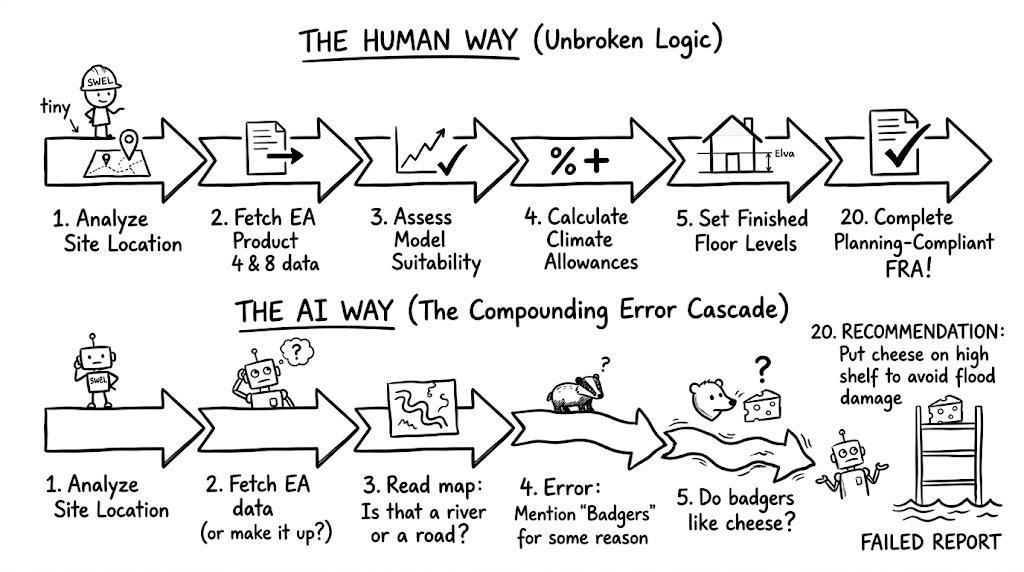
How a multi-step logical chain stays on track versus how compounding errors can cause AI to completely miss the mark (and worry about badgers eating cheese).
1. The “From £295” Google Ad Trick
When you see an advert offering a Flood Risk Assessment for £295 or £300, one of two things is happening:
- It is a lead-capture bait price: In several cases, if you click on a “From £295” Google advert, the £295 price does not actually exist anywhere on the company’s website. Instead, you are directed to a quote form. Once a consultant looks at your site and sees it is in Flood Zone 2 or 3, or requires a Sequential Test, the real quote comes back in four figures.
- It is an automated map printout for a low-risk site: Where £300 reports do exist, they are basic desktop screening documents for minor domestic extensions or simple Flood Zone 1 validation checks. They pull free, open-source maps from the internet and drop them into a pre-written template within 48 hours.
If your site is in Flood Zone 2 or 3, a £300 template report will not get you through planning. A site-specific Flood Risk Assessment requires ordering and reviewing Product 4 data and breach hazard models directly from the Environment Agency (which takes up to 20 working days to arrive), checking whether the underlying hydraulic model is still fit for purpose, setting accurate Finished Floor Levels, and preparing a Flood Warning and Evacuation Plan or local Sequential Test. None of that is included in a £300 fee.
2. We Tested AI Automation—Here Is Why It Fails on Reports
We are not anti-technology at Southwest Environmental Limited. In fact, I recently spent a significant amount of time setting up an autonomous AI system on a Linux machine in our office to test what it could reliably handle.
Before letting it anywhere near an environmental report, I gave it what should have been a very simple office task: watch an email inbox for an invoice trigger, read the matching row from a spreadsheet, and place those five pieces of text onto fixed points on a PDF invoice.
It failed repeatedly. In fact, it got that basic task wrong in so many different ways that I eventually pulled the plug on it.
The reason it failed highlights a major flaw in current AI models: they are reasonably accurate at answering one single question at a time, but they fall apart when a task requires a long chain of decisions.
Writing a Flood Risk Assessment or a Phase 1 Desktop Study is not a single question. It is a chain of 20 to 30 linked technical judgements. A human consultant has to look at historical Ordnance Survey maps, read Environment Agency flood depth and flow data, check LiDAR ground contours, spot a culverted watercourse behind a railway embankment, and work out how water will actually flow across a specific plot of land.
Current AI cannot reliably read engineering maps or spatial data, and if it makes a small mistake at Step 2 of a 25-step chain, the final flood mitigation advice at Step 25 is completely wrong. When hundreds of thousands of pounds of land value or development costs ride on a planning application, “mostly right” is useless.
3. Planning Officers Don’t Want a Sci-Fi Novel
There is another problem when people let AI loose on a full report: the tone of voice. Left to its own devices, AI writes like a bad sci-fi novel. It stuffs paragraphs full of dramatic words and strange phrases that no UK engineer or planner actually uses.
Local Planning Authority case officers and Environment Agency consultees do not want dramatic adjectives. They want flat, plain, accurate facts: exact flood levels in metres Above Ordnance Datum (m AOD), clear surface water drainage calculations, and a sensible argument showing how the design meets national and local planning policy.
4. Where AI Actually Helps (And Where Humans Are Still Required)
While AI cannot write a full report from scratch without making a mess of it, it is genuinely useful when kept on a short leash and steered by a human consultant. At SWEL, we find it works well for two specific things:
- Processing raw datasets: Quickly sorting or formatting large tables of environmental or hydrological data.
- Checking policy updates: Reviewing individual report sections to flag where national guidance or planning policy paragraph numbers (such as the August 2026 NPPF updates) have changed.
Even then, any time saved on admin is quickly eaten up by rising regulatory complexity—whether that is Biodiversity Net Gain (BNG) metric calculations, Preliminary Ecological Appraisals (PEAs), Phosphate Assessments, or stricter surface water drainage rules.
The Bottom Line
If your project is a simple house extension in a low-risk area, a cheap screening report might be all you need. But if you are submitting a planning application on a complex site or in a higher-risk flood zone, there is still no substitute for an experienced human consultant reviewing the data, making a reasoned professional judgement, and standing behind the report with full Professional Indemnity insurance.
Need a Straightforward Quote for a Planning Report?
Whether you need a Flood Risk Assessment, Sequential Test, Desktop Study, or Phosphate Assessment, contact Southwest Environmental Limited with your site postcode and planning details. We will tell you plainly what your local authority requires and give you an honest price for the work.
Call our regional offices for a free initial discussion: Bristol (01173 270 092) | Exeter (01392 927 961) | London (02076 920 670) | Manchester (01612 970 026)