
Lighting Assessment Completed for Residential Project in Torquay, Devon
Southwest Environmental Limited (SWEL) recently delivered a comprehensive, short lead-time lighting assessment for a residential dwelling redesign in Torquay, Devon, within the Torbay Council planning authority area.
The site is bordered by mixed woodland and residential gardens, where records confirm the presence of light-sensitive species, including the Greater Horseshoe Bat (Rhinolophus ferrumequinum). The primary objective was to deliver a compliant lighting strategy for residential occupancy while mitigating artificial light spill into sensitive ecological receptors.
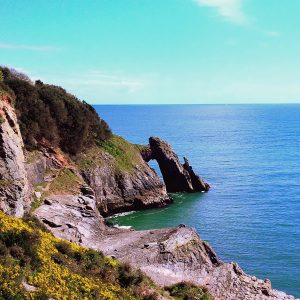
London Bridge Arch along the coastal cliffs in Torquay, Devon.
Legislative Framework and Industry Standards
Lighting assessments must demonstrate compliance with strict national policy and technical guidance to secure planning approval. Key regulatory frameworks evaluated during this project include:
- Legislation: Section 102 of the Planning (Clean Neighbourhoods and Environment) Act 2005, which addresses artificial light emitted from premises that may cause a nuisance or be prejudicial to health.
- National Policy: Paragraph 125 and Annex 2 of the National Planning Practice Guidance (NPPG), which require development decisions to limit light pollution impacts on local amenity and nature conservation.
- Technical Standards: Guidance Note ILP GN01:2021 (The Reduction of Obtrusive Light) and the joint Bat Conservation Trust / ILP guidelines for bat-sensitive lighting schemes.
Design Strategy and Ecological Mitigation Measures
To restrict light trespass, SWEL developed a targeted mitigation design. Quantitative light spill modelling was conducted across horizontal ground planes and vertical 18-metre boundary planes adjacent to the tree lines.
The mitigation strategy specified:
- Zero Uplighting: Elimination of all ground-mounted or upward-directed luminaires across the site to prevent sky glow.
- Luminaire Specifications: Low-power LED downlights (2700K–3000K colour temperature) fitted with horizontal cut-offs, PIR sensors, and dawn-to-dusk controls, restricted to external doorways.
- Glazing Mitigation: Application of specialized tinted film on south and west elevations, reducing internal light transmission through glazing by up to 95%.
Quantitative Results and Assessment Conclusions
The resulting illuminance contours confirmed that horizontal light spill remains below 0.5 lux in immediate proximity to the dwelling, dropping below 0.2 lux across wider adjacent spaces and woodland areas. Vertical luminance along northern, eastern, southern, and western boundaries is predominantly maintained between 0.2 and 0.4 lux, well below threshold levels that would disrupt bat foraging or commuting behavior.
Through rapid evaluation and precision modeling, SWEL demonstrated that the proposed scheme yields a negligible impact on ecological receptors and dark sky environments.
Please contact us if you would like a fixed price quotation.